



By Kennedy Elaigwu Awodi

For decades, the conversation around poverty reduction and humanitarian intervention in Nigeria has been plagued by a fundamental paradox: the citizens who need government support the most are often the hardest for the state to see, verify, and reach. When a family is uprooted by conflict or climate shocks, they rarely flee with folders of birth certificates, National Identification Number (NIN) slips, or active bank accounts. Without legal identity or financial inclusion, millions of internally displaced persons (IDPs) and rural poor become invisible to the formal economy, trapped outside the very safety nets designed to rescue them.

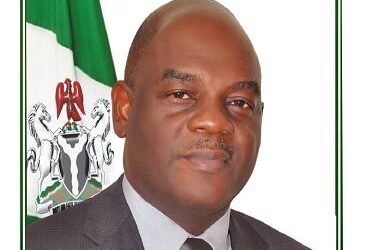
Looking closely at the milestones recorded by the Federal Ministry of Humanitarian Affairs and Poverty Reduction over the past week, it is increasingly clear that the Honourable Minister, Dr. Bernard M. Doro, has diagnosed this structural bottleneck with surgical precision. Combining the analytical discipline of his background in clinical practice, law, and IT-driven business strategy, Dr. Doro is steering the Ministry away from tokenistic charity toward a systemic, technology-enabled architecture of inclusion.
Nowhere was this strategic vision more evident than at the United Nations House in Abuja, where Dr. Doro launched the Mobile One-Stop Shop initiative and handed over 10 specially equipped service vehicles to participating states. Executed in partnership with the United Nations High Commissioner for Refugees (UNHCR) and funded by the Government of Germany, the initiative is a masterclass in practical governance. Rather than expecting impoverished, displaced Nigerians in remote camps across states like Borno, Adamawa, Benue, Katsina, and Cross River to travel long, expensive distances to urban registration centres, Dr. Doro has literally put the state on wheels.
The genius of the Mobile One-Stop Shop lies in its integration of civil identity with economic empowerment. Within a single mobile unit, a displaced citizen can obtain a birth certificate, enrol for a National Identification Number (NIN), generate a Bank Verification Number (BVN), register a SIM card, open a bank account, and be captured into the National Social Register. By collapsing five separate bureaucratic hurdles into one accessible visit, Dr. Doro is restoring legal personhood and financial citizenship to the margins of society.
Equally commendable is his no-nonsense administrative posture during the handover: charging state governments to ensure the vehicles are properly fueled, secured, and deployed to the field, rather than left gathering dust in government yards, signals a leader obsessed with measurable field impact rather than ceremonial photo opportunities.
This commitment to transparency, accessibility, and systemic integrity is equally visible in the Ministry’s handling of the National Emergency Relief and Stabilisation Intervention (NERSI), the Federal Government’s ₦50,000 non-repayable relief grant for vulnerable households. Historically, cash transfer schemes in Nigeria have suffered from two chronic ailments: opaque beneficiary selection riddled with political patronage, and digital exclusion that leaves non-smartphone users behind.
Under Dr. Doro’s watch, the NERSI rollout has been deliberately engineered to eliminate both vulnerabilities. Throughout the past week, the Ministry maintained an aggressive, transparent public enlightenment campaign clarifying that beneficiary selection is strictly automated through the National Social Register and verified identity records across all six geopolitical zones. By repeatedly warning citizens against paying intermediaries, middlemen, or fraudulent agents, and backing that warning with a dedicated helpline—the Minister has erected a strong firewall against the rent-seeking networks that once preyed on desperate citizens.
Perhaps most impressive is the sheer pragmatism of the disbursement design. Recognising that millions of Nigeria’s poorest citizens operate basic feature phones without internet access, Dr. Doro’s Ministry partnered with five major digital financial platforms, ALAT, MoMo PSB, NairaGram, OPay, and Moniepoint, to enable full ₦50,000 withdrawals via simple USSD codes.
A grandmother in a rural community does not need data, a smartphone, or a connection to a local politician to claim her support; she simply dials a USSD string on her basic phone, gives consent, and receives every kobo without deductions.
Furthermore, Dr. Doro’s ability to attract and sustain high-level international goodwill, evidenced by his recent engagements with the European Union delegation alongside the seamless execution of the German-backed UNHCR mobile initiative, speaks volumes about institutional credibility. Global development partners are notoriously cautious with their resources; they invest heavily where they see policy coherence, data-driven accountability, and verifiable delivery mechanisms.
Ultimately, true poverty reduction is not achieved by handing out temporary palliatives in the dark; it is achieved by building transparent systems that treat vulnerable citizens with dignity. From rolling out mobile registration hubs that bring the government to the doorstep of the displaced, to safeguarding a USSD-driven cash relief programme against middlemen, Dr. Bernard Doro is proving that humanitarian governance can be both deeply compassionate and rigorously modern. If this momentum is sustained and scaled across all 36 states and the Federal Capital Territory, Nigeria’s social protection framework will stand as one of the most resilient and inclusive on the continent.
Kennedy Elaigwu Awodi wrote from North Carolina, USA.