

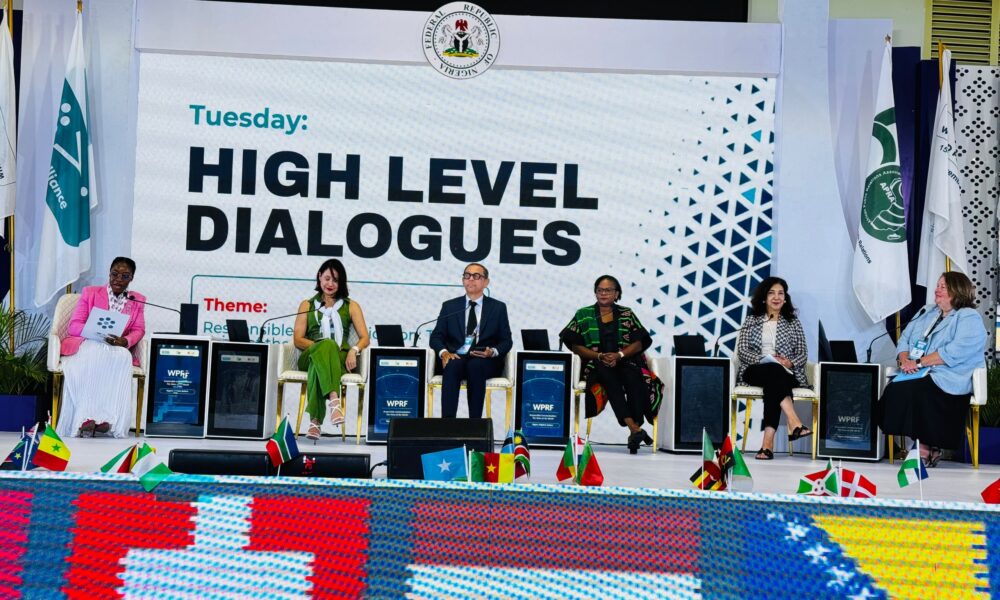



In an era saturated with press releases, algorithmic spin, and curated social media narratives, a blunt warning echoed across the plenary hall of the Transcorp Hilton, Abuja, on Tuesday morning: you cannot communicate your way out of bad leadership.

Speaking during the morning plenary session titled “Ethical Leadership and Trust in a Divided World” at the ongoing 2026 World Public Relations Forum (WPRF), international communication strategists and governance scholars dismantled the enduring myth that clever public relations can paper over institutional failures, broken promises, or ethical lapses.

With global trust in political institutions, corporations, and media fractured by polarization and digital misinformation, the session, featuring renowned US crisis management strategist Prof. Helio Fred Garcia, Reputation Lighthouse CEO Ms. Bonnie Caver, and moderated by Barr. Chimdi Neliaku, mnipr, recentered public relations around a simple but demanding premise: character and conduct must precede messaging.
The Danger of the “Say–Do” Gap
For decades, embattled governments and corporate boards have frequently treated public relations as an emergency cosmetic tool, summoning communicators only after a policy backfires, a scandal erupts, or community resentment boils over. According to Ms. Bonnie Caver, Chair of the Global Alliance North America Regional Council, that approach no longer survives modern scrutiny.
Caver warned that organizations inflict deep, lasting damage on their credibility when they announce ambitious social initiatives or community partnerships without following through, creating what strategists call the “say–do gap.”
Instead of hiding behind generic surveys or sanitized press statements, Caver urged leaders to step outside their boardrooms and engage directly with employees, customers, and host communities to listen to their lived realities. In a hyper-connected age where every citizen holds a smartphone, authenticity cannot be outsourced to a publicity campaign.
She also challenged practitioners to elevate the standards of their craft rather than blending into the noise of everyday digital chatter.
”Everybody in the world is a communicator,” Caver told delegates. “My son, who’s an engineer, is a communicator. My son, who’s a scientist, is a communicator. In today’s world, everyone is a communicator. We are not communicators. We’re communication professionals.”
Ethics as the Foundation of Trust
Delivering the session’s keynote perspective, Prof. Helio Fred Garcia, President of Logos Consulting Group and Professor of Ethics, underscored that public trust is not a rhetorical trick, it is the predictable byproduct of ethical behavior sustained over time.
When leaders treat communication as a substitute for accountability, audiences quickly recognize the disconnect between words and actions. In a divided world, where skepticism toward authority is already high, spin does not merely fail; it actively accelerates cynicism and institutional decay.
For public relations professionals, the mandate is therefore not to defend the indefensible, but to sit at the decision-making table early enough to counsel leaders toward right action before a crisis is born.
Leadership Precedes Communication
Synthesizing the dialogue, session moderator Barr. Chimdi Neliaku, mnipr, Chair of the Nigerian Institute of Public Relations (NIPR) Young Professionals Hub, emphasized that leadership must precede communication if institutions hope to rebuild public confidence.
True institutional credibility, she noted, is forged through genuine relationships, emotional intelligence, and strong, transparent systems, not episodic publicity blitzes. Turning her attention to the next generation of practitioners gathered in Abuja from across 126 countries, Neliaku issued a direct charge on personal accountability:
”We must also start to build a record of conduct that our own generation will be trusted on and judged on.”