

By Kennedy Elaigwu Awodi

History rarely grants a nation the luxury of passive governance during moments of existential strain. Today, Nigeria stands at a profound historical watershed, a crossroads where the choices made by its citizens, youth, and political class will determine whether the fabric of our Republic holds strong or yields to the forces of fragmentation.

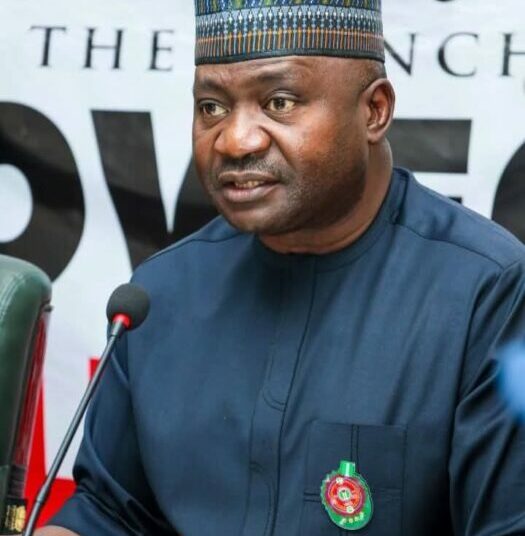
It was against this backdrop that Hon. AARE Abdulmajeed Oladimeji Oyeniyi, National Speaker of the Oodua Youth Parliament, stepped forward at the Nigerian Union of Journalists (NUJ) press center in Lagos. Speaking with the full weight of Southwest youth leadership, his press address was far more than a routine media statement; it was a trenchant manifesto for national survival, security cohesion, and civic responsibility.
At its core, the address delivers an unassailable truth that every patriotic Nigerian must now confront: national security cannot be treated as a political football, nor can it be borne as the sole burden of a single ministry or minister. When the security architecture of a nation is under pressure, targeted cynicism and armchair criticism serve only the enemies of the state. The Minister of Defence and the entire leadership of the Ministry are taskmasters carrying an extraordinarily complex operational burden.
To demand total peace while simultaneously withholding civic cooperation, actionable intelligence, and moral support is a fundamental contradiction. The Minister’s policy directives, aimed at modernizing defence logistics, improving inter-agency harmony, and recalibrating counter-insurgency doctrines, require time, national alignment, and unyielding support to bear full fruit.
This call for synergy extends directly to the frontlines, where the strategic direction of military leadership translates into physical security for millions. Hon. Oyeniyi’s deliberate commendation of the Chief of Defence Staff, General Christopher Musa, highlights a crucial pillar of our current national posture. Leadership in warfare is as much about morale and discipline as it is about firepower. Under General Musa, the Armed Forces of Nigeria have demonstrated a renewed sense of professionalism, operational flexibility, and devotion to duty.
From the difficult terrains of the North-East to the dense creeks of the Niger Delta and the forest belts of the South-West, gallant men and women in uniform put their lives on the line daily so that ordinary citizens can sleep with both eyes closed. Praising their sacrifice is not mere rhetoric; it is a vital act of national gratitude that bolsters the resolve of troops facing asymmetric threats.
Yet, operational bravery on the battlefield can easily be undermined by political recklessness at home. The most vital section of the Oodua Youth Parliament’s address was its timely and firm admonition directed at former political leaders, specifically addressing the recent inflammatory conduct associated with the former Governor of Kaduna State. In a constitutional democracy, free speech is a cherished right, but it is not an absolute license to set the house on fire. Leaders who have held high public office owe the nation a debt of restraint. When former stewards of public trust resort to utterances that fan sectarian flames, question the legitimacy of national security efforts, or politicize fragile peace, they cross the line from healthy opposition into national detriment.
Words have power; they can aggregate trust or spark widespread crisis. The warning issued by the youth of the Oodua nation serves as a necessary guardrail. Political ambitions and personal grievances must never be elevated above the survival of the Federal Republic. Undermining the morale of military commanders or heating up the polity during a delicate security transition is a dangerous gamble that benefits neither the North, the South, nor any ethnic nationality within our borders.
The stance taken by the Oodua Youth Parliament reflects a mature, forward-thinking youth demographic that recognizes its role as the backbone of nation-building. By choosing unity over division, support over cynical partisan critique, and constructive engagement over destabilization, Southwest youth have set a precedent for youth organizations across all geopolitical zones.
Nigeria belongs to every citizen, but its future belongs overwhelmingly to its youth. Securing that future requires shielding our security institutions from bad-faith politics and rallying behind those tasked with guarding the realm. The Minister of Defence and our military leadership have shown the resolve to fight for Nigeria’s integrity; it is now the duty of the citizenry, media, traditional institutions, and political actors to offer the unwavering support required to win the peace.
Kennedy Elaigwu Awodi wrote from North Carolina, USA.
Email: awodiken@outlook.com