



For decades, the dominant narrative surrounding Africa’s energy landscape was defined by structural paradox: a continent richly endowed with vast crude oil reserves, yet fundamentally dependent on foreign nations to refine that crude into usable fuel.

This historical reliance not only exposed African economies to global supply-chain shocks and severe foreign exchange depletion, but it also stalled local industrialization. Today, that paradigm is undergoing a decisive shift. Driven by massive private enterprise and strategic cross-border partnerships, Africa is increasingly building the domestic infrastructure required to process its own resources.

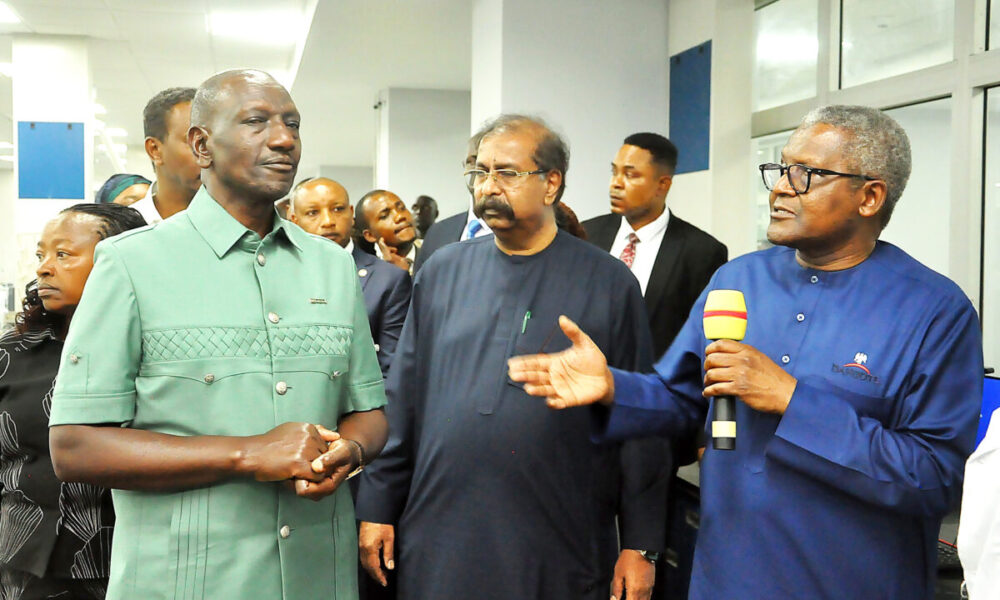
At the center of this transformation is the Dangote Group, whose ambitious expansion, highlighted by Kenyan President William Ruto’s recent landmark visit to its flagship Lagos facility, signals the arrival of a genuinely integrated, pan-African industrial era.
President Ruto’s characterization of the 700,000 barrel-per-day (bpd) Dangote Petroleum Refinery in Lagos as a “masterpiece of science, engineering, and art” reflects more than polite diplomatic praise; it acknowledges a historic engineering feat executed on African soil. Seeing the scale and operational sophistication of the world-class facility firsthand served as a validation for East Africa’s own energy ambitions.
Most notably, the visit solidified Kenya’s commitment to partner with the conglomerate on a proposed $17 billion East African Oil Refinery and Petrochemical Complex in Lamu. Positioned as a 700,000 bpd greenfield project, the Lamu facility is designed not merely as a domestic asset for Kenya, but as a critical regional hub intended to enhance energy security, foster engineering talent, and accelerate industrialization across the entire East African bloc.
This cross-regional synergy illustrates how private capital, paired with strong political will, can bypass administrative bottlenecks to address continent-wide challenges. As President Ruto noted, the Kenyan government has already secured the necessary land and committed to eliminating bureaucratic delays to expedite construction.
Grounding this operational momentum is a $450 million contract signed with Engineers India Limited (EIL) for project management and engineering procurement, leveraging the exact expertise that successfully delivered the Lagos megaproject.
Concurrently, Dangote Group is advancing plans to double its original Nigerian refining footprint to approximately 1,4 million barrels per day through the addition of a second crude distillation unit. Together, these parallel developments in West and East Africa establish a formidable infrastructure framework capable of anchoring African energy self-sufficiency.
Beyond the physical steel and concrete, the strategic trajectory of the Dangote Group reflects a broader financial and economic milestone for the continent. Anchored by its Vision 2030 strategy, the conglomerate generated approximately $17 billion in revenue in the first half of 2026 alone and remains on track to achieve a record $36 billion for the full year, effectively doubling its 2025 performance.
With plans to double its $50 billion capital expenditure baseline over the next five years, the group’s overarching objective is to build a $100 billion pan-African industrial enterprise. By reinvesting revenues across cement, fertilizer, logistics, power generation, and refining, the enterprise demonstrates how home-grown African industrial giants can compete on a global scale while simultaneously solving foundational development challenges at home.
Ultimately, the alignment between state vision and corporate execution marks a turning point for African economic integration. Projects like the Lagos and Lamu refining complexes do far more than process crude oil; they retention value within the continent, generate high-skilled technical employment, and protect national currencies from structural import dependencies.
As African leaders increasingly look inward for industrial solutions, the partnership between public governance and private enterprise stands as a powerful blueprint for Africa’s economic renaissance—proving that the continent possesses both the vision and the capability to fuel its own future.