



The traditional boundaries of advertising are dissolving. In an age where digital platforms dictate consumer choices, algorithms curate visibility, and generative artificial intelligence challenges traditional human creativity, Nigeria’s marketing communications ecosystem stands at a historic crossroads.
Against this backdrop, the Advertising Regulatory Council of Nigeria (ARCON) convened the 4th Advertising Industry Colloquium (AIC 4.0) at D’Podium Event Centre in Ikeja, Lagos. Gathering policymakers, sectoral leaders, academics, digital innovators, and ambitious students, the event served as a crucible for reimagining how advertising is taught, practiced, and regulated in a rapidly evolving digital landscape.

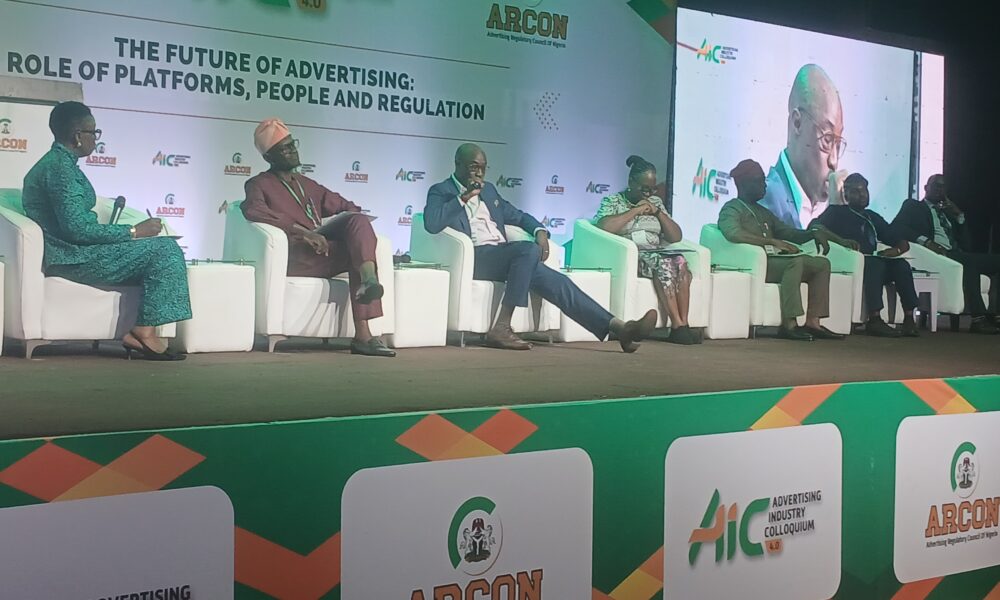
Held under the theme “The Future of Advertising: The Role of Platforms, People and Regulation,” AIC 4.0 tackled the urgent need for structural transformation across the creative ecosystem.
At the core of the colloquium is ARCON’s “Town and Gown” initiative. Historically, a disconnect has existed between academic theory taught in tertiary classrooms (“gown”) and the fast-paced, tech-driven demands of agency boardrooms (“town”). ARCON’s initiative bridges this gap by:
Aligning mass communication and advertising curricula with contemporary industry realities, digital analytics, and AI tools.
Fostering direct mentorship between veteran practitioners, agency chiefs, and undergrad talent. Also immersing students in live campaign creation, strategic pitch dynamics, and real-world brand problem-solving.
Delivering the address on behalf of the Chief Host and the Honourable Minister of Information and National Orientation, Alhaji Mohammed Idris Malagi, the Director-General of the Voice of Nigeria (VON), Mallam Jibrin Baba Ndace, highlighted the changing nature of advertising.
”Advertising has evolved far beyond selling products,” the Minister stated. “It now shapes culture, influences public perception, drives economic activity, promotes national identity, and supports democratic participation.”
The Minister emphasized the Federal Government’s commitment under President Bola Ahmed Tinubu to positioning Nigeria as Africa’s premier hub for creative excellence and digital enterprise. He pointed to nationwide investments in fibre-optic infrastructure aimed at lowering internet costs, expanding broadband access to underserved areas, and unlocking new avenues for digital commerce.
While acknowledging AI’s ability to streamline content generation, the Minister reminded attendees that the human element remains irreplaceable:
”Artificial Intelligence can process data and execute visuals, but authentic storytelling, deep cultural resonance, emotional intelligence, and ethical judgment are uniquely human capabilities.”
He urged regulators to adopt consultative, forward-looking models rather than restrictive barriers, viewing regulation as an enabler of sustainable market growth.
Welcoming participants, the Director-General of ARCON, Dr. Olalekan Fadolapo, reinforced that the future of advertising cannot be built in silos. He noted that as digital touchpoints multiply, regulation must remain agile to preserve brand equity, protect consumer rights, and nurture home-grown talent.
Serving as Chairman of the Occasion, Mallam Jibrin Baba Ndace stressed that public communication organs and regulatory authorities must shed legacy methodologies. In a borderless digital ecosystem, legacy approaches must yield to adaptive engagement that supports local content creators, indigenous IP, and emerging agency models.
In a keynote address, Olu Akanmu, Academic Director of the Tech-Leap Initiative at Lagos Business School (LBS), dissected the structural shift sweeping global media.
Akanmu noted that advertising has entered the “Platform Economy,” where tech monopolies own the underlying infrastructure, process consumer behavioral data, determine content visibility through predictive algorithms, and mediate brand interactions.
”We cannot use analogue practices and methods to regulate digital media,” Akanmu asserted. “Regulation needs to be agile in tandem with the nature of digital media.”
Drawing parallels to the Central Bank of Nigeria’s progressive fintech regulation, specifically the creation of a specialized payments department to support innovation rather than police it, Akanmu challenged ARCON to spearhead a co-regulatory framework. He proposed establishing a Digital Advertising and Marketing Advisory Council incorporating tech platforms, creators, influencers, and digital-first agencies.
The panel discussion further deepened these insights through a rich dialogue across academia, brand management, outdoor media, and regulatory ethics.
Olu Akanmu reiterated the urgency of agile regulation, urging regulators to abandon legacy enforcement in favor of co-regulation that tracks real-time digital realities without stifling creative freedom.
Dozie Mbanefo (MD/CEO, New Crystal Communication Limited) focused on the rapid evolution of Out-of-Home (OOH) media, explaining how static billboards are giving way to programmatic Digital Out-of-Home (DOOH) networks. He urged closer synergy between academics and operators so graduates understand data-driven media buying and location-based analytics.
Prof. Adepoju Tejumaiye (Head of Department, Mass Communication & Advertising, UNILAG) represented the academic perspective, calling for continuous, dynamic curriculum reviews. He emphasized that universities must embed AI tools, programmatic ad buying, and social media analytics directly into undergraduate coursework so students graduate market-ready.
Dotun Babatunde (Head of Digital Marketing, Olam Agri) presented the brand custodian’s point of view, noting that while generative AI streamlines content creation, human emotional intelligence, cultural nuances, and data privacy compliance remain essential to establishing long-term brand trust.
Omowunmi Owodunni (Former Chairman, Advertising Standards Panel) addressed the critical dimension of ethics, stressing that digital platform growth must not come at the expense of consumer protection. She advocated for clear vetting guidelines covering influencer marketing, user-generated ad content, and digital health/financial claims.
Adding powerful industry backing, the leadership of the Heads of Advertising Sectoral Groups (HASG) delivered strong goodwill messages commending ARCON’s Director-General for sustaining the colloquium. For instance, Lanre Adisa (President of AAAN and Chairman of HASG) pledged that creative agencies would continue opening their doors for student internships and practical pitch training to feed the talent pipeline.
Dozie Okafor (President of MIPAN) praised the alignment of classroom theory with media strategy, affirming MIPAN’s commitment to advancing transparent audience measurement metrics and digital media planning. Sola Akinsiku (President of OAAN) highlighted the enthusiasm within outdoor advertising as it shifts toward smart digital display networks, while Tolulope Medebem (President of EXMAN) emphasized how modern experiential marketing merges physical consumer touchpoints with augmented reality (AR) and live digital extensions.
Representing broadcast media, Dr. Gregory Odutayo (on behalf of BON) reiterated support for indigenous content creators, broadcast innovation, and hybrid digital-terrestrial advertising models.
The competitive centerpiece of AIC 4.0 was the Inter-Tertiary Institution Advertising Pitch Competition, where six universities representing Nigeria’s geopolitical zones presented fully fleshed-out integrated marketing campaigns before a panel of veteran judges. The presentations demonstrated exceptional strategic planning, consumer insights, digital execution, and dynamic delivery.
1st Place (Overall Champion): Kwara State University (KWASU) which took home the price of one million naira was celebrated for its data-driven insights, multi-platform strategy, and high presentation pitch. 2nd Place (1st Runner-Up): University of Ilorin (UNILORIN) took home the price of seven hundred and fifty thousand naira.
3rd Place (2nd Runner-Up): Rivers State University (RSU) went home with five hundred thousand naira. 4th Place: Kaduna State University (KASU) 5th Place: Lagos State University (LASU). 6th Place: Ebonyi State University (EBSU).