


By Paul Onehi

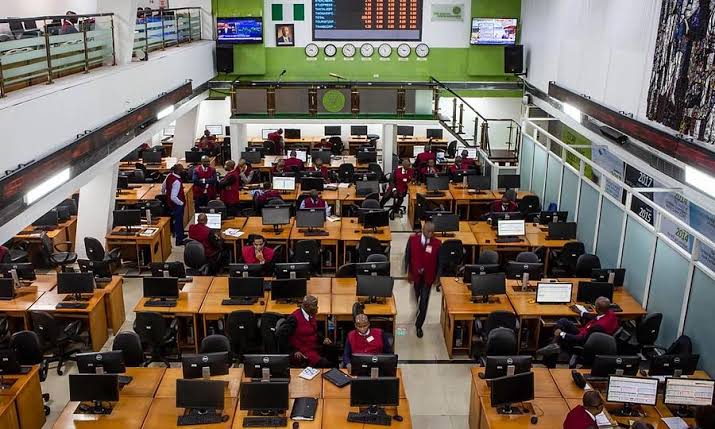
Nigeria’s equities market recovered approximately ₦2.20 trillion in market capitalisation during the week ended Friday, November 13, 2026, as renewed investor interest in selected stocks helped reverse losses recorded in the previous trading week.

Data from the Nigerian Exchange (NGX) showed that the All-Share Index (ASI) appreciated by 1.36 per cent week-on-week, closing at 252,269.16 points, compared with 248,877.22 points recorded on November 6.
Consequently, equity market capitalisation increased from ₦161.59 trillion to approximately ₦163.80 trillion, representing a significant recovery in the overall value of listed equities.
The market’s year-to-date return also strengthened to 62.11 per cent, underscoring the strong performance of Nigerian equities since the beginning of the year.
However, the market’s positive weekly performance contrasted with Friday’s trading session, which ended marginally lower following profit-taking in selected heavyweight stocks.
The benchmark index declined by 0.04 per cent from 252,366.80 points recorded on Thursday to 252,269.16 points. The marginal decline reduced market capitalisation by approximately ₦63.41 billion.
Sectoral performance reflected renewed interest in selected equities, particularly within the insurance and industrial goods segments.
The Industrial Goods Index advanced by 0.36 per cent, while the Banking Index gained 0.34 per cent during Friday’s session.
The Insurance sector also attracted significant trading interest, with stocks such as AIICO and LASACO featuring among the equities that recorded price appreciation.
Meanwhile, the Oil and Gas sector faced renewed pressure, declining by 0.94 per cent, making it the weakest-performing sector during the session.
At the individual stock level, Caverton Offshore Support Group led the market’s gainers, appreciating by 10 per cent to close at ₦4.40 per share. FTGINSURE followed with a 9.93 per cent gain, while Austin Laz and LASACO advanced by 9.91 per cent and 9.20 per cent, respectively.
On the losing side, Multiverse Mining and Exploration recorded the steepest decline, shedding 9.90 per cent to close at ₦17.30 per share.
Trading activity presented an interesting development, as the volume of shares exchanged increased substantially despite a significant decline in transaction value.
Approximately 3.70 billion shares valued at ₦23.11 billion were exchanged in 27,205 deals during Friday’s session. This represented a 26.86 per cent increase in trading volume compared with 2.91 billion shares recorded in the previous session.
However, transaction value declined by approximately 70.62 per cent from ₦78.66 billion, while the number of deals fell by 3.93 per cent from 28,318 transactions.
The disparity between trading volume and transaction value suggests that the increase in activity was concentrated in relatively high-volume, lower-value transactions rather than a corresponding expansion in the overall amount of capital deployed.
Market data further showed that LINKASSURE accounted for approximately 3.10 billion shares, representing 83.90 per cent of total traded volume.
FIRSTHOLDCO, meanwhile, led transactions by value, recording approximately ₦7.33 billion in trades, equivalent to 31.71 per cent of the day’s total transaction value.
Despite Friday’s marginal decline, the market’s weekly recovery indicates that investors continued to identify opportunities across selected equities following the previous week’s losses.
According to market analysis published by Nairametrics, investors took advantage of relatively attractive entry prices in selected insurance, oil and gas, industrial goods and commodity stocks. Nevertheless, the mixed performance of the benchmark index and trading indicators suggests that investors remain selective in their positioning.
With the market’s year-to-date return standing at 62.11 per cent, attention will increasingly focus on corporate earnings, sectoral performance and broader economic developments as investors assess opportunities in the remaining trading sessions of the year.
For the Nigerian equities market, the immediate challenge will be sustaining the recovery while translating increased trading participation into broader and more consistent buying interest.