

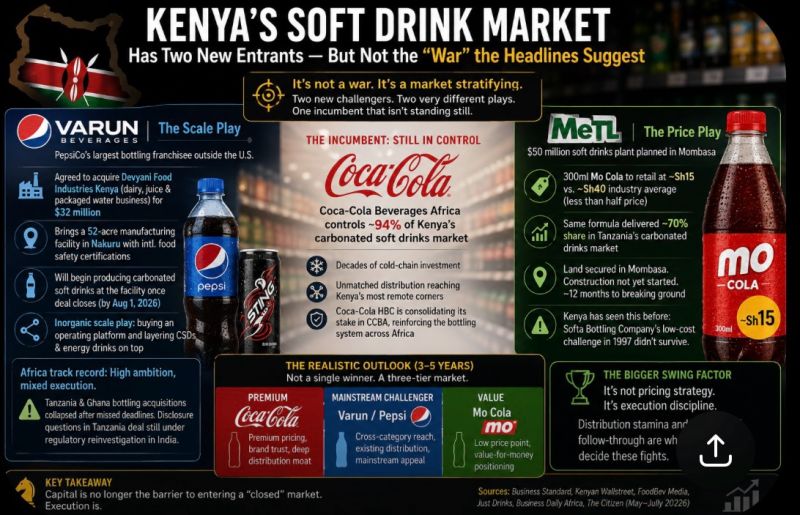




Kenya’s carbonated soft drink industry is entering a new era of intense market competition as two major beverage players roll out distinct expansion strategies aimed at breaking the long-standing dominance of Coca-Cola Beverages Africa (CCBA).

The incoming market disruptions stem from two different business models targeting distinct market segments:

Varun Beverages (Mainstream Expansion): PepsiCo’s largest bottling partner outside the U.S. is acquiring the dairy, juice, and bottled water business of Devyani Food Industries Kenya for $32 million. Expected to close by August 1, 2026, the deal gives Varun control of a certified 52-acre production facility in Nakuru. The company plans to leverage this existing operational infrastructure to introduce soft drinks and energy drinks across multiple categories.
MeTL Group (Low-Price Value Strategy): Tanzania’s MeTL Group is targeting price-sensitive consumers by planning a $50 million beverage manufacturing plant in Mombasa for its flagship Mo Cola brand. MeTL intends to price Mo Cola at approximately Sh15 per bottle, substantially below the prevailing market price of around Sh40. While land has been secured in Mombasa, groundbreaking is expected within the next year.
Coca-Cola Beverages Africa, which has maintained an estimated 60% to 70% share of Kenya’s soft drink market for over a decade, is reinforcing its market control by leveraging its vast nationwide cold-chain infrastructure and deepening collaboration across its distribution networks.
Industry analysts note that distribution efficiency and sustained operational capabilities will prove more critical than initial price cuts. While MeTL’s aggressive pricing previously captured significant market share in Tanzania, Varun Beverages brings extensive international scale despite facing recent regulatory reviews and transaction delays in neighboring African markets.
Market experts predict that competition will not devolve into a simple price war. Instead, over the next three to five years, Kenya’s beverage landscape is expected to stratify into distinct premium, mainstream, and value segments, offering consumers broader product options across various price tiers.
Source: Brand Spur Business News Desk