

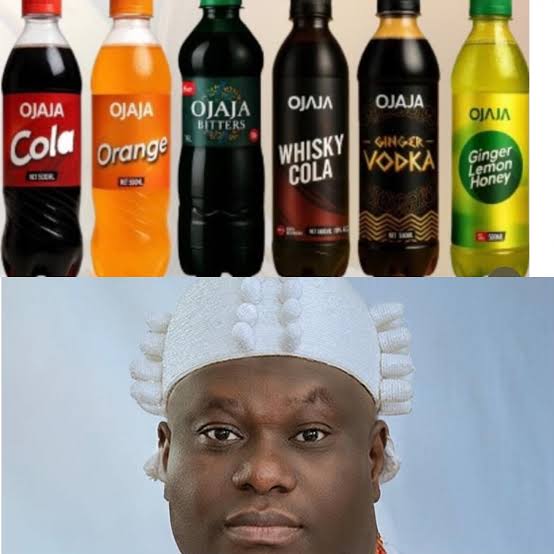




The Nigerian carbonated soft drink (CSD) market is one of the most competitive, volume-driven, and price-sensitive FMCG sectors in Africa. Ranked among the largest soft drink markets globally, Nigeria has historically been dominated by multinational giants, though indigenous manufacturers have increasingly proven that local brands can disrupt established order.

It is within this dynamic landscape that OJAJA Cola, a proudly Nigerian soft drink brand, was introduced. Owned by OJAJA Pan Africa Limited through its subsidiary OJAJA Drinks, the brand represents an ambitious attempt to blend indigenous heritage, natural ingredients, and local industrial capacity.

Launch Timeline and Brand Origins
OJAJA Cola’s journey began as part of a broader corporate push by His Imperial Majesty, Oba Adeyeye Enitan Ogunwusi (Ojaja II), the Ooni of Ife, to promote industrialization, economic self-reliance, and “Made in Africa” excellence. Initial strategic announcements and product reveals occurred around April 2024 when early beverage lines were previewed.
However, the formal commercial rollout of OJAJA Soft Drinks, featuring flagship variants OJAJA Cola and OJAJA Orange, took place in early 2026 (unveiled around February 2026 and scaled up with canned variants in April 2026). The brand specifically emphasizes a local supply chain, utilising natural African ingredients including authentic kola nut extracts and ginger nuances to offer a distinct flavor profile.
Acceptability and Current Popularity
At present, OJAJA Cola is in its early-to-mid growth phase. Its initial popularity is largely concentrated in South West Nigeria, with primary retail distribution starting in major urban and commercial centers such as Lagos, Akure, and Ile-Ife.
The brand enjoys high initial acceptance among culturally conscious consumers and institutional buyers. The brand name carries the prestige of the ancient stool of Ife, giving it an immediate identity as an authentic, indigenous product.
While OJAJA Cola is widely discussed in news media and digital spaces due to its high-profile royal sponsor, its everyday consumer penetration across northern and eastern Nigeria remains a work in progress compared to ubiquitous household brands.
Monarchical Entrepreneurship
The involvement of a paramount traditional ruler like the Ooni of Ife in commercial ventures often sparks intense debate. Critics question whether royal prestige should be intertwined with commercial market risks. However, a deeper historical and global analysis reveals that this is neither unusual nor unprecedented.
Traditional Context
In Yoruba traditional society, the Oba was historically not just a spiritual custodian but also the primary patron of trade, agriculture, and guild crafts. In a modern developing economy facing inflation and unemployment, modern royal leadership often extends into industrial philanthropy, creating jobs, building local value chains, and setting standards for economic self-determination.
Global Benchmarks
Monarchs and royal houses around the world have long engaged in commercial enterprise to support local economies. For instance, in United Kingdom, King Charles III (as Prince of Wales) established Duchy Originals in 1990 (now Waitrose Duchy Organic), producing organic food, biscuits, and beverages. The profits fund charitable endeavors while promoting sustainable local farming.
Also, the Princely House of Liechtenstein owns and operates LGT Group (private banking and asset management) as well as the Hofkellerei wine estates. In Thailand, King Bhumibol Adulyadej created the Royal Project Foundation, which birthed commercial agricultural brands like Doi Kham, famous for processed fruits, juices, and cold beverages.
In United Arab Emirates, members of the Dubai and Abu Dhabi royal families actively own and front major commercial conglomerates spanning aviation, real estate, and consumer goods.
Seen through this global lens, the Ooni of Ife’s leadership of OJAJA Pan Africa aligns with an established tradition of royal entrepreneurship meant to catalyze local industry.
Juxtaposition with Existing Indigenous Brands
Nigeria’s carbonated drink market features several notable home-grown successes, particularly from the South West and Northern regions. Juxtaposing OJAJA Cola against these established players highlights distinct strategic paths:
The Bigi Benchmark
Rite Foods Limited’s Bigi Cola fundamentally altered Nigeria’s soft drink landscape in 2016. By offering a larger bottle size (60cl) at a lower price point during an economic recession, Bigi disrupted the long-standing duopoly of Coca-Cola (NBC) and Pepsi (Seven-Up Bottling Co.).
Unlike Bigi, which entered the market purely on a price-volume disruption model, OJAJA Cola enters with a cultural-premium narrative, aiming to win consumers through emotional equity, natural local formulations, and regional pride.
Expert Opinions: Can OJAJA Cola Dominate a Saturated Market?
FMCG analysts and marketing experts generally agree that the Nigerian CSD market is near saturation, characterized by slim profit margins, intense price wars, and massive capital requirements for logistics.
Some these experts based their arguments on the fact that, soft drinks are impulse purchases heavily dependent on distribution density and cold-chain availability.
According to them, a new entrant cannot dominate without thousands of third-party distributors, branded chillers, and hawker incentive structures.
Experts conclude that outright domination over Coca-Cola, Pepsi, and Bigi is highly improbable in the short term. However, total market dominance is not required for commercial success. OJAJA Cola can carve out a lucrative, sustainable business by dominating regional channels across South West retail networks and Ojaja Mall ecosystems. Leveraging health-conscious positioning via natural ingredients and ginger/kola nut extracts. Exporting to African diaspora markets across Europe and North America, where cultural affinity commands a premium price point.
OJAJA Cola represents a bold effort to turn cultural identity into a competitive commercial asset. While overcoming distribution hurdles in a market dominated by entrenched incumbents will require substantial capital and time, the brand’s unique blend of royal patronage, natural local ingredients, and regional pride gives it a distinct platform to thrive.