

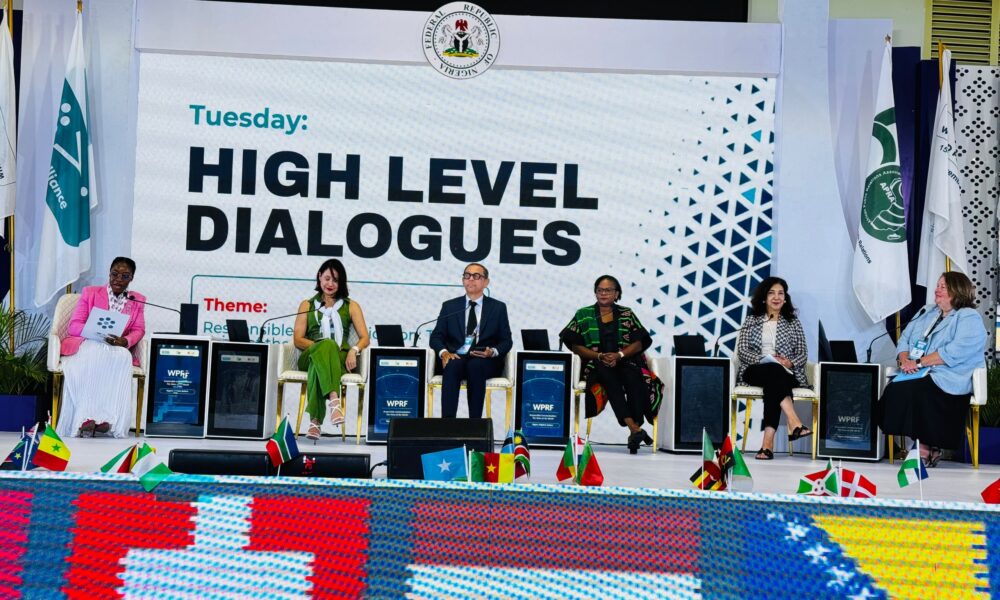




For five days in November 2026, the federal capital of Abuja became the nerve centre of global communication. Inside the plenary halls and breakout sessions of the Transcorp Hilton Hotel, more than a thousand delegates, policymakers, diplomats, scholars, and communication practitioners from over 120 countries gathered for the 13th World Public Relations Forum (WPRF 2026).

Hosted in West Africa for the first time and coinciding with the 25th anniversary of the Global Alliance for Public Relations and Communication Management, the summit arrived under an unmistakable banner: “Responsible Communication: The Voice of the World.”

Yet beneath the diplomatic ceremony, keynote speeches, and continental milestones lay a sharper, more demanding interrogation of the profession itself. Across panel after panel, speakers confronted an uncomfortable truth facing governments, corporations, and civil institutions alike: in an age of fractured trust, rapid digital manipulation, and skeptical publics, communication can no longer function as cosmetic cover for weak policies, delayed reforms, or broken commitments. If public relations is to command respect at the highest levels of governance and enterprise, it must be anchored in verifiable action, ethical conduct, and institutional accountability.
The significance of hosting WPRF 2026 in Abuja was felt well beyond the conference halls. For decades, global public relations forums largely unfolded in Western or Asian capitals, leaving African practitioners frequently cast as observers rather than agenda-setters. In Abuja, that dynamic shifted. Global Alliance President and CEO Prof. Justin Green acknowledged the strength of Nigeria’s bid and the backing of President Bola Ahmed Tinubu, while African Public Relations Association (APRA) President Arik Karani captured the mood of continental arrival when he declared that, for the first time, Africa was truly at the table in shaping global public relations discourse.
That sense of institutional momentum was reinforced by a landmark policy announcement during the opening ceremony. Representing President Tinubu, Vice President Kashim Shettima announced formal Federal Government approval for the establishment of the University of Public Relations and Leadership in Gudi, Akwanga Local Government Area, Nasarawa State, the first specialized university of its kind in the world.
Commending the Nigerian Institute of Public Relations (NIPR), the Federal Ministry of Information, and the Nasarawa State Government for driving the initiative, the Vice President framed ethical communication not as an ornamental add-on to statecraft, but as an essential pillar of national security, social cohesion, and public accountability.
At the same time, speakers were careful not to confuse global visibility with automatic credibility. Vice President Shettima challenged negative stereotypes about Nigeria by pointing to its dynamic technology ecosystem and projected population growth toward 440 million by 2050, while Minister of Information and National Orientation Mohammed Idris emphasized that responsible communication must defend truth without stifling legitimate dissent.
Citing pan-African collaboration alongside the UNESCO Category 2 International Media and Information Literacy Institute (IMILI) in Abuja, Idris underlined the urgency of countering misinformation and artificial-intelligence-driven falsehoods through media literacy and institutional openness.
Closing the “Say–Do” Gap
If policymakers set the macro-strategic context, a morning plenary titled “Ethical Leadership and Trust in a Divided World” stripped the conversation down to raw organizational reality.
Moderated by Barr. Chimdi Neliaku, mnipr, Chair of the NIPR Young Professionals Hub, and featuring US crisis management strategist Prof. Helio Fred Garcia alongside Reputation Lighthouse CEO and Global Alliance North America Regional Council Chair Ms. Bonnie Caver, the session dismantled a persistent illusion: that clever messaging can rescue bad leadership.
Too often, organizations summon communicators only after a policy stumbles, a product crisis erupts, or community anger spills into the open. Caver pointed directly to the damage caused by the “say–do gap”—the widening chasm between lofty corporate pledges or community announcements and what institutions actually deliver on the ground.
In a world where virtually every citizen carries a smartphone and can document contradictions in real time, audiences spot performative publicity immediately.
Caver urged leaders to step out of echo chambers and boardrooms to listen directly to employees, customers, and host communities about their lived realities.
She also drew a sharp distinction between casual commentary and disciplined practice, reminding delegates that while everyone today has a voice and a platform, true authority belongs to trained professionals who uphold standards, ethics, and evidence.
Prof. Garcia reinforced that point from the vantage point of ethics and crisis strategy. Trust, he argued, is not manufactured through rhetorical spin; it is the earned byproduct of consistent, ethical conduct over time. When leaders treat public relations as a substitute for accountability, spin does not merely fail, it deepens public cynicism and accelerates institutional erosion. The real value of a strategic communicator lies in advising decision-makers early, before flawed choices harden into public crises.
Neliaku brought that challenge home to the rising generation of practitioners gathered from 126 countries, reminding them that credibility is built through emotional intelligence, transparent systems, and a personal record of conduct that peers and publics can trust.
Nowhere was the marriage of communication and operational reform illustrated more concretely than in the address by Dr. Bashir Adewale Adeniyi, MFR, Comptroller-General of the Nigeria Customs Service (NCS) and Chair of the World Customs Organisation (WCO) Council.
Speaking during a special partnership session alongside Minister of Foreign Affairs Ambassador Bianca Odumegwu-Ojukwu and Minister of Finance and Coordinating Minister of the Economy Taiwo Oyedele, Adeniyi made an unambiguous case: no press statement, however polished, can conceal poor service delivery for long. One frustrating experience at a port or border post can undo years of careful reputation work.
Rather than burying uncomfortable operational metrics, Adeniyi pointed to the Service’s decision to publish its Time Release Study, which showed cargo clearance averaging five days, with over 90 per cent of that time lost to idle delays. Full disclosure was not an exercise in self-flagellation; it was a diagnostic tool to expose bottlenecks across the trade ecosystem and compel shared accountability among agencies, operators, and logistics partners.
He also highlighted the Authorised Economic Operator (AEO) programme as proof of what happens when operational reform is paired with early, transparent stakeholder engagement. By aligning frontline officers and traders around clear expectations, clearance timelines for compliant businesses dropped sharply from roughly 168 hours to 41 hours, benefiting over 200 companies, with 51 fully certified.
As Adeniyi put it, reform is not finished when a system goes live; it is finished when the people using it understand it and trust it.
On security-sensitive matters, however, he stressed a different discipline: accuracy and operational safety must always outrank speed. Citing major arms seizures, including 844 rifles intercepted in June 2024 and 399 rifles recovered aboard the vessel MV Velika, he explained that restraint and timely coordination protected intelligence work and innocent lives.
His five guiding principles, communicating before action, telling the truth, verifying facts, demonstrating tangible results, and listening attentively to stakeholders, offered a practical blueprint for public institutions under pressure.
Those same themes echoed across governance and international diplomacy. Imo State Governor Senator Hope Uzodimma argued that navigating difficult economic transitions, such as the removal of the petrol subsidy, which he noted had disproportionately benefited middlemen despite short-term household strain, requires candid dialogue, clear policy rationales, and grassroots stakeholder engagement so citizens understand why sacrifices are being asked and how long-term recovery will work.
Similarly, Minister of State for Foreign Affairs Ambassador Bianca Odumegwu-Ojukwu warned that unchecked disinformation can inflame diplomatic tensions, insisting that trust is built into action rather than treaties alone, and calling for stronger institutional responsiveness and journalist access.
Alongside multilateral voices such as EU Ambassador to Nigeria and ECOWAS Gautier Mignot, delegates also rallied behind the Global Alliance’s push for Responsible Communication to be recognized by the United Nations as an 18th Sustainable Development Goal.