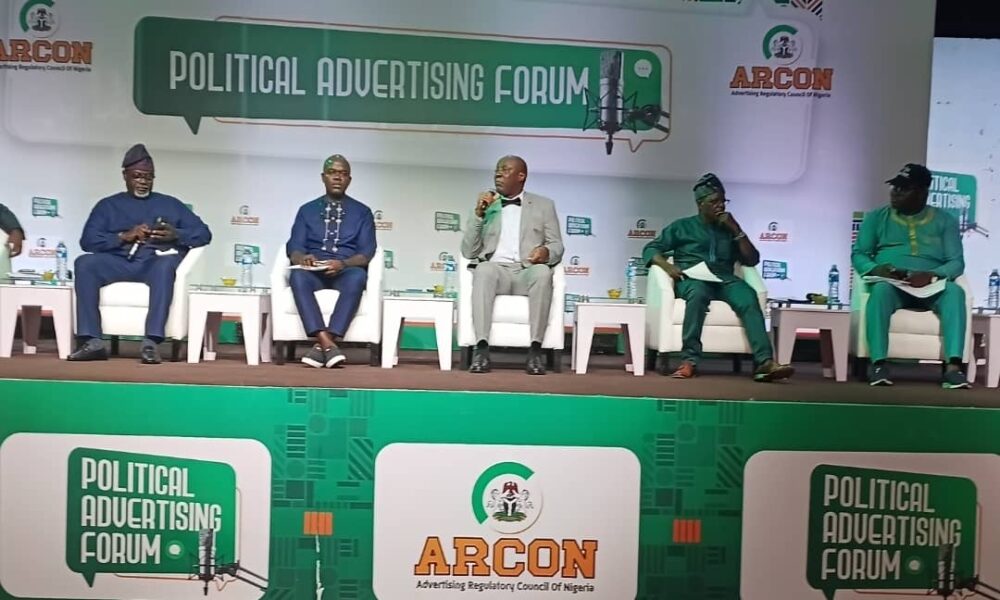



Political communication serves as the bedrock of any vibrant democracy, serving as the primary vehicle through which candidates communicate vision, policy, and ideology to the electorate. However, when unregulated, political advertising can deteriorate into a tool for misinformation, character assassination, and social polarization. Recognizing these dangers ahead of the 2027 general elections, the Advertising Regulatory Council of Nigeria (ARCON) recently convened a landmark Political Advertising Forum in Lagos recently.

Bringing together regulatory bodies, sectoral heads, media owners, and legal experts, the forum underscored a clear imperative: ethical compliance, legal accountability, and public interest must govern all political campaigns across traditional and digital media spaces.

The event opened with a compelling welcome address by the Director-General of ARCON, Dr. Olalekan Fadolapo, who set a firm regulatory tone for the upcoming election cycle. Dr. Fadolapo cautioned political parties, candidates, media organizations, and campaign managers against deploying unvetted or inflammatory advertising materials. Emphasizing that political messages carry immense power to shape public sentiment, he reiterated that all campaign collateral, spanning television, radio, print, billboards, and social media, must undergo mandatory screening and approval by the Advertising Standards Panel (ASP) prior to public exposure.
Furthermore, the Director-General warned that non-compliance would attract strict sanctions, holding not only the political actors accountable but also the media houses and digital platforms that broadcast unapproved content.
Building upon the regulatory framework outlined by ARCON, the keynote address delivered by Barrister Charles Odenigbo, Director-General of the Centre for Media Law & Development (CMLD), provided deep legal context to campaign ethics. Centered on the theme “Compliance Must Start at Conceptualisation,” Barrister Odenigbo reminded stakeholders that the ARCON Act, the Nigerian Code of Advertising, the Electoral Act, and the Nigeria Broadcasting Code are legally binding statutes designed to protect national stability.
He urged political strategists to move away from exploitative rhetoric that leverages tribal, religious, or personal fault lines. Instead, campaigns must focus on issue-driven narratives that inform and empower voters. By incorporating legal and regulatory guidelines right from the creative concept stage, agencies can avoid post-production rejections, costly fines, and legal entanglements.
Echoing these sentiments, goodwill messages from leaders across the advertising ecosystem reinforced the industry’s commitment to self-regulation and professionalism. Lanre Adisa, Chairman of the Heads of Advertising Sectorial Groups (HASG), called on practitioners to resist external pressures from political patrons demanding the release of unvetted or provocative advertisements.
Recognizing the commercial temptation during election cycles, Adisa stressed that the long-term credibility of the advertising profession relies on integrity.
Representatives from the Out-of-Home (OOH) media sector also highlighted operational realities, such as unauthorized campaign postings, exorbitant municipal levies, and security risks facing outdoor infrastructure, calling for fairer playing fields and structured enforcement.
The subsequent panel discussions delved into the practical mechanics of regulatory compliance, digital monitoring, and electoral coordination. Industry experts and ASP officials detailed the streamlined submission processes for political ads, urging early submissions to prevent delays.
A major focus of the panels was the rapidly evolving digital landscape. Panelists examined the challenges posed by social media influencers, deepfakes, and AI-generated content, agreeing that digital platforms must be held to the same rigorous vetting standards as traditional broadcast channels.
Furthermore, discussions highlighted the necessity of close collaboration between ARCON, the Independent National Electoral Commission (INEC), and the National Broadcasting Commission (NBC) to ensure seamless enforcement, particularly regarding the mandatory pre-election campaign silence period.