

The ongoing renovation of the Yakubu Gowon Stadium in Port Harcourt has become a story of two narratives: one centered on the transformation of a historic sporting facility into a world-class arena, and another driven by allegations of delayed payments, bribery demands and the realities of executing public infrastructure projects in Nigeria.

As work intensifies on the 16,000-capacity stadium, Rivers State officials insist that the project remains on course despite public concerns over restricted access to the facility. At the same time, the contractor handling the project has publicly challenged the government over what he describes as unpaid contractual obligations and undue pressure from unnamed interests.

Speaking while leading journalists on an inspection tour of the stadium complex, the Coordinating Commissioner for Sports and Attorney-General and Commissioner for Justice, Barrister Chris Green, dismissed claims that members of the public or organizations had been unfairly denied access to the facility.
“The Yakubu Gowon Stadium is an active construction site. There are heavy-duty machines, sensitive installations and ongoing engineering works everywhere. I have not received any application whatsoever, and if anyone claims otherwise, let them present the proof,” Green said.
The commissioner challenged proponents of the allegations to provide evidence of any application that had allegedly been rejected by the state government.
According to him, the extensive reconstruction project is being undertaken to elevate the stadium to FIFA and World Athletics standards, making it capable of hosting top-level football and athletics competitions.
Green stressed that the scale and technical complexity of the ongoing work make the facility unsafe for public gatherings at this stage, necessitating strict access control until major phases of construction are completed.
His remarks came against the backdrop of growing public interest in the project and an exclusive on-site interview granted by the contractor responsible for the renovation.
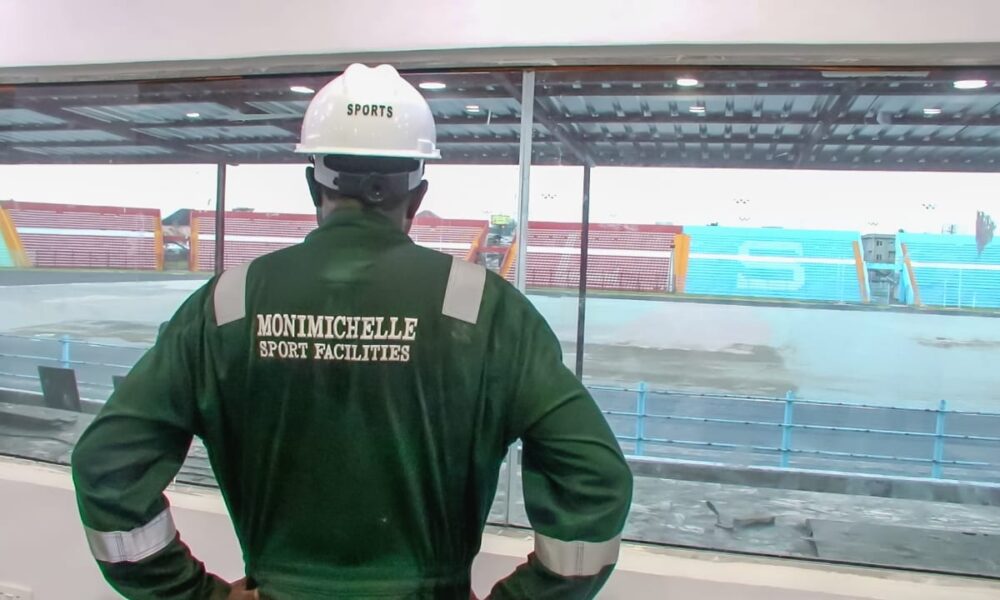
Managing Director of Monimichelle Sports Construction Company, Ebi Ezekiel Egbe, used the RSTV visit to showcase what he described as significant progress on one of Rivers State’s most ambitious sports infrastructure projects.
Awarded in 2025, the contract aims to transform the Yakubu Gowon Stadium into a modern multi-purpose sporting venue capable of meeting FIFA, CAF and World Athletics certification requirements.
Walking journalists through the site, Egbe pointed to visible signs of advancement across the facility.
The pitch foundation, he said, has been fully completed with 4,000 perforated drainage pipes installed beneath the playing surface. The sprinkler system is ready for deployment, while the base for the polyurethane athletics track has already been asphalted.
Work on the VIP and VVIP sections is nearing completion, with tiling and finishing ongoing. Roof trusses have been erected, cladding works are approximately 90 per cent complete, the scoreboard structure has been fabricated, floodlight installations are being prepared and the public address system has already been delivered to the stadium.
Officials from the Rivers State Ministry of Works were also present during the inspection.”The job is more than 90 per cent complete. We are here every day,” Egbe said.
Further more, one of the major questions surrounding the project has been the absence of a completed football pitch and athletics track despite the reported level of progress.
Egbe explained that the delay is strategic rather than technical. According to him, the Nigerian Army is scheduled to host its annual Army Day celebration at the stadium around July 7, an event expected to involve heavy vehicles and extensive movement within the facility.
Installing the pitch before the event, he argued, would expose the surface to avoidable damage.
“We don’t want to install the pitch because there’s going to be a very serious activity here by the Nigerian Army. There will be a lot of vehicles going around the track, and we want to protect the main bowl facilities,” he explained.
Egbe noted that polyurethane track surfaces are best installed during dry weather conditions and that attempting installation during the peak of the rainy season could compromise quality and durability.
Despite the delay, he maintained that all required materials for both the pitch and track have already been imported and are available on site.
With Rivers United expected to participate in continental competitions and CAF inspectors scheduled to visit before September, the contractor acknowledged that timelines remain critical.
“Rivers United need to play continental games here. The pitch must be ready before September,” he said.
While construction progress was evident across the site, it was Egbe’s comments regarding project funding that generated the strongest reactions.
The contractor openly questioned whether the government had fulfilled its financial obligations under the contract.
“Ask them have they paid us? I challenge anybody that says we don’t finish their job. I’m live on TV. Have they paid us?” he asked.
Throughout the interview, he repeatedly returned to the issue of delayed payments, describing what he characterized as one of the greatest challenges facing contractors working on public projects.
He painted a picture of prolonged bureaucracy and uncertainty that often follows project execution. “If you finish a government job, come back for payment 100 years. Your children will see the money. You go die, nobody can answer you,” he said.
Although visibly frustrated, Egbe maintained that his company remained committed to delivering the project according to agreed specifications.
“We work with government money. We don’t hide it. If I’m doing your job, I will do your job and give you the best money can buy. But you must pay,” he stated.
Perhaps the most controversial aspect of the interview was Egbe’s allegation that certain individuals demanded kickbacks ranging from ₦2 billion to ₦3 billion from the contract.
Describing such demands as unacceptable, he argued that surrendering such sums from a ₦7.4 billion contract would undermine the integrity of the project and jeopardise delivery.
“It’s criminal. How can I be doing a job of ₦7.4 billion and give out ₦2 billion? That makes me a criminal,” he said.
Egbe insisted that any legitimate profit earned by his company should come only after the successful completion of the work and not through what he described as unlawful financial expectations.
At the time of publication, no evidence supporting the allegations had been publicly presented, and the Rivers State Government had not issued a formal response to the claims.
Despite his concerns over payment delays and alleged pressure from external interests, Egbe’s enthusiasm for the project remained evident throughout the interview.
He spoke passionately about the significance of delivering a FIFA-standard facility in Rivers State and the opportunities such infrastructure could create for football, athletics and sports tourism.
“I’m very happy to be part of history in Rivers State because this is going to be history,” he said.
For Rivers State, the completion of the Yakubu Gowon Stadium would represent more than a construction milestone. It would potentially provide one of Nigeria’s most modern sporting venues and strengthen the state’s position as a destination for major national and international sporting events.
As the project moves toward its final stages, attention will increasingly shift from construction progress to delivery timelines, certification requirements and operational readiness.
The successful completion of the pitch and athletics track remains crucial, particularly with CAF inspections looming and Rivers United’s continental ambitions in focus.
For now, the stadium stands as both a symbol of progress and a focal point of controversy.
Government officials insist that restrictions are necessary to guarantee safety and protect ongoing work. The contractor insists that project is nearing completion despite financial challenges.
What remains unresolved are the questions raised publicly during the inspection.
Has the contractor been paid in accordance with contractual obligations? What response, if any, will the government provide to the allegations made during the interview? And when will the renovated stadium finally be ready to welcome athletes and fans back through its gates?
Until those answers emerge, the Yakubu Gowon Stadium renovation remains one of the most closely watched sports infrastructure projects in Nigeria.