

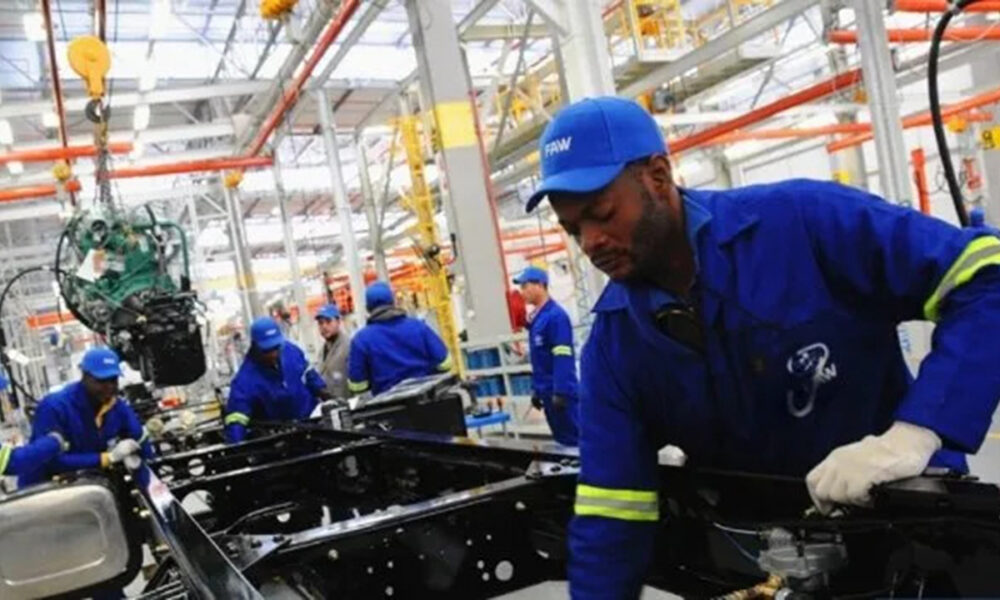




Nigeria’s real sector stands at a critical juncture, defined by remarkable sector-specific resilience alongside persistent regional imbalances. According to recent data released by the Manufacturers Association of Nigeria (MAN), the food, beverage, and tobacco sector emerged as the premier destination for industrial capital in 2025, absorbing ₦375.03 billion in fresh investments.

This marks a sharp 63.5 percent surge from the ₦229.42 billion recorded in 2024, signaling robust confidence in the country’s vast fast-moving consumer goods (FMCG) market. Yet, beneath these impressive figures lies a glaring structural divide: the overwhelming concentration of industrial capital within the Lagos-Ogun commercial corridor, leaving the nation’s remaining 34 states largely on the periphery of manufacturing growth.

The influx of capital into the food and beverage industry was propelled by major market players—including Flour Mills of Nigeria, BUA Foods, Nestlé Nigeria, Dangote Sugar, Dufil, Cadbury Nigeria, CHI Limited, Unilever Nigeria, and Honeywell Flour Mills, all expanding operations to capture domestic demand. Overall manufacturing investments reached ₦1.33 trillion in 2025, distributed across several key sub-sectors:
While industrial diversification across sub-sectors remains encouraging, geographic capital allocation exhibits acute polarization. Between 2024 and 2025, Lagos and Ogun states collectively captured ₦1.74 trillion, representing 87.32 percent of all manufacturing investments nationwide. In contrast, Nigeria’s remaining 34 states combined accounted for just ₦252.23 billion, or roughly 12.7 percent.
This concentration is not accidental; it is driven by fundamental economic and infrastructural advantages.
As noted by Dr. Muda Yusuf, CEO of the Centre for the Promotion of Private Enterprise (CPPE), and economic consultant Nonso Ihuoma, access to functional seaports remains the primary determinant of factory site selection. Proximity to Apapa, Tin Can Island, and the Lekki Deep Sea Port significantly reduces raw material import lead times and export logistics costs.
Capitalizing on its border with Lagos, Ogun State has developed world-class industrial hubs in Agbara, Igbesa, Ota, and Sango-Ota. Historical MAN data shows that between 2014 and 2020, Ogun attracted 50.16 percent (₦1.68 trillion) of total national manufacturing investments, offering lower land acquisition costs compared to congested Lagos centers.
For the remaining 34 states, attracting industrial capital requires tackling severe systemic headwind—most notably poor inter-state road networks, inadequate rail links to inland dry ports, high interstate transit tariffs, and localized insecurity.
To foster balanced regional industrialization, economists and policy analysts advocate three urgent interventions:
Inland Port & Maritime Decentralization: Accelerating the operationalization and dredging of regional ports (such as Calabar, Warri, and Port Harcourt) alongside inland dry ports to lower freight overheads outside the South-West.
Targeted Regional Investment Incentives: Developing special economic zones (SEZs) featuring tax holidays, guaranteed power off-take, and streamlined land titling in northern and eastern industrial hubs.
Infrastructural Security Guarantees: Securing vital agrarian and transport corridors to ensure unhindered movement of agricultural inputs from farming regions to processing centers.
The record growth of Nigeria’s food, beverage, and manufacturing sectors demonstrates the fundamental strength of its consumer market. However, sustaining long-term national economic resilience requires moving beyond a single industrial corridor. By expanding maritime access, securing transport networks, and creating targeted investment incentives across all geopolitical zones, Nigeria can transform localized manufacturing wins into an inclusive, nationwide industrial boom.