

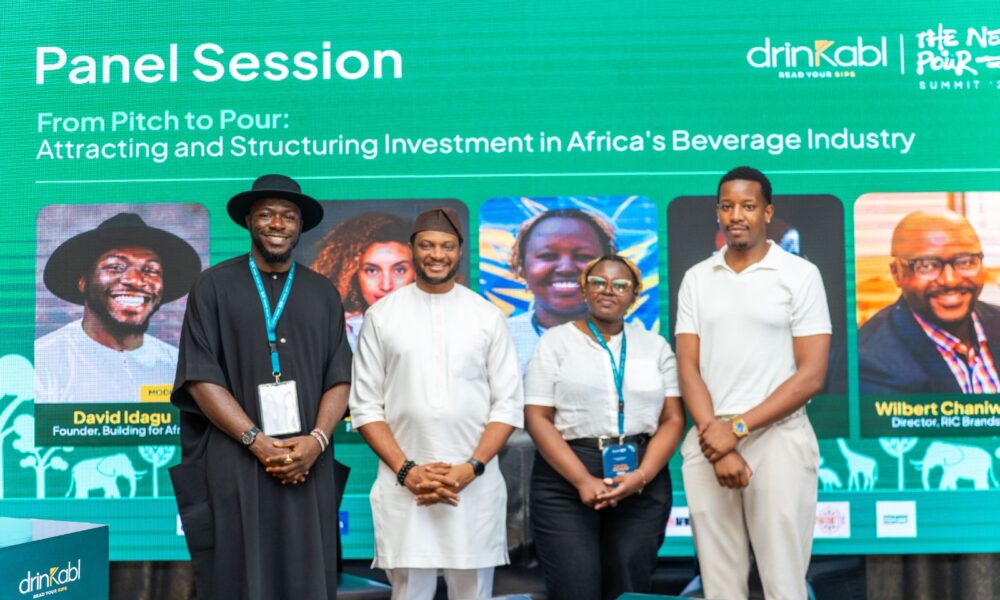



Capital is flowing south. That was the central message at The New Pour Summit 2026, convened by Drinkabl Africa, where beverage leaders, founders, and investors gathered to build actionable frameworks to scale African drinks from concept to global markets.

Launched in Nairobi, Kenya, the summit brought together African and global beverage strategists, innovators, and funders around a single goal: to turn Africa’s demographic dividend into commercial dominance.

“The New Pour Summit is designed to bring together the thinkers, doers, and investors shaping the future of African beverages,” said Tosin Balogun, Co-Founder, Drinkabl Africa, and Convener of The New Pour Summit.
“We are moving from ideas to execution, building brands that start in Africa and scale globally. Investment follows clarity, and our goal is to bring absolute clarity to the African beverage ecosystem.”
A core focus was what makes an African beverage business fundable. In the Structuring Investment in Africa’s Beverage Industry masterclass, Kanessa Muluneh, Founder of Nyle, shared her journey from an Ethiopian coffee-farming family to building a beverage brand on the continent.
“Investors, of course, look at money. I’m not going to spin around that. But we want to work long-term. Story is everything, especially when it comes to beverages,” Muluneh said. “In Africa, we don’t have enough beverage brands, by far.”
The Pitch to Pour panel expanded on this, with founders and advisors outlining what investors need to see: scalable fundamentals, financial discipline, owned IP and supply, and resilience.
“My strategy has always been to be so good that we can’t be ignored. We couldn’t find distribution, so we built our own,” said Brian Kiriba, Founder, Handas Juice.
“Building in Africa requires a certain kind of madness to navigate. The word that resonated across every speaker today was resilience,” added facilitator David Idagu, Building for Africa.
Investors heard how real-time intelligence is de-risking bets. Josiah Kimanzi, Actnable AI, demonstrated how AI tools using WhatsApp, SMS, and facial-expression analysis can simulate market response at a fraction of the cost. “If you’re old school, you’re using the stairs. AI is a lift,” he said.
Panelists agreed that the client-agency relationship must evolve into a partnership with shared data to move from descriptive to predictive insight. “Businesses are looking for foresight. It has to evolve into a partnership,” said Seyi Adeoye, Pierrine Consulting.
Cultural intelligence also emerged as a commercial driver. Feyi Olubodun, Open Squares Africa, introduced the Villager Framework, showing how African consumers modernise without westernising. His Uganda study found that infusing culture into point-of-sale design can lift brand patronage by up to 65%. “You must win in Africa, and that means you must know Africa beneath the skin,” he said.
The formula was proven by EABL’s Manyatta cider. Effie Thiongo, Head of Innovation East Africa, detailed how a drink rooted in the Manyatta homestead sold over 10 million bottles and generated double-digit USD million revenue. “The authenticity that makes us Manyatta is our edge,” the panel concluded.
The summit closed with the launch of the inaugural New Pour Report 2026, based on 10 trends and over 15 data sources. It identifies why capital is shifting toward Southern and Sub-Saharan Africa on the back of demographics, urbanisation and connectivity.
“What you’re holding is ten trends shaping the flow of capital into the Global South, in which Africa is the critical market,” said Balogun. “This is our intellectual commitment to Africa’s beverage industry. It’s the inaugural report, and we don’t plan on stopping.”
Key trends include situational consumption, premiumisation of local drinks, wellness, cross-border scalability, and “return on culture” — a term coined by Franklin Ozekhome, Pop Culture Varsity: “From return on investment, we must now start looking at return on culture.”
To access all the presentations and information about the summit, Balogun encouraged professionals, industry leaders, media, and students to visit https://newpour.drinkabl.media/recap.html
With one in five youths worldwide set to be African within 15 years, the summit’s call was clear: build with the African consumer at the center.
“Asamani,” Balogun added, “the future of the beverage industry belongs to those who build with the African consumer at the center.”