

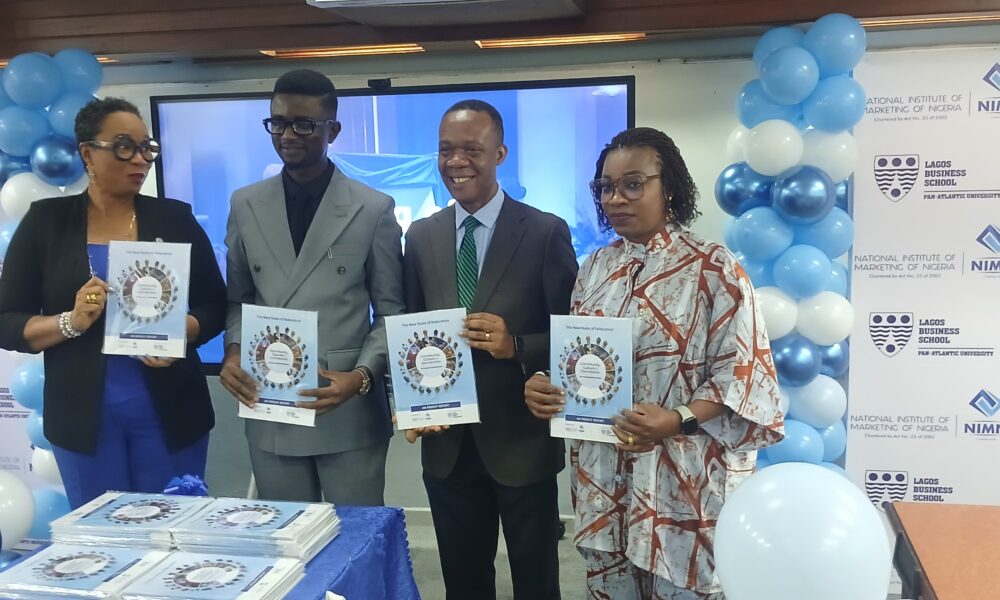



The National Institute of Marketing of Nigeria (NIMN), in a strategic partnership with the Lagos Business School (LBS), has officially unveiled its highly anticipated insights report titled, Community, Culture, and Connection: Re-imagining the New Market.
The comprehensive research piece offers a data-driven blueprint for corporate leaders, entrepreneurs, and policymakers seeking to navigate the fast-evolving economic and social landscape of the Nigerian market.

Welcoming distinguished guests, industry captains, and journalists to the launch event, the Registrar of NIMN, Thelma Okoh, described the report as an objective, unvarnished lens through which to view the future of commerce in Nigeria.
”When we speak of community, culture, and connection, we are speaking the very language of Nigeria,” Okoh stated. “In Nigeria, community is our safety net and our launchpad. The ‘New Market’ is no longer just a physical space or a digital platform; it is a communal ecosystem where trust is the primary currency. Nigerian consumers do not just buy products; they buy into stories, identities, and heritage.”
A core objective of the report is addressing the historic lack of localized consumer data. Speaking on the report’s insights, Emmanuel Adediran emphasized that the initiative aimed to validate long-standing market assumptions and directly capture consumer sentiment. “The narrative that Nigeria does not have data has to change,” Adediran noted.
The report delves deeply into modern marketing dynamics, particularly the changing efficacy of influencer marketing. While acknowledging that influencer partnerships still yield results, the report introduces critical nuances for contemporary brands. Notably, it highlights a shifting preference toward micro- and nano-influencers over macro-celebrities.
Crucially, the research distinguishes between standard influencers and true community leaders who command deep, loyal followership. The report urges corporate brands to move away from superficial alignments and instead focus on collaborating with these grassroots leaders or actively building their own brand-owned communities.
Reflecting on the genesis of the project, the President of NIMN, Dr. Bolajoko Bayo-Ajayi, expressed profound excitement at seeing a strategic vision transition into reality. The idea was birthed during the planning stages of the institute’s annual conference as a way to create an impactful, lasting conversation that extended far beyond the event itself.
”We established a strategic town and gown partnership with the Lagos Business School to ensure that what is being taught in the classroom truly resonates with today’s market reality,” Dr. Bayo-Ajayi explained.
To ensure national representation and rigorous objectivity, the research methodology encompassed extensive focus group discussions and detailed interviews with both corporate entities and everyday consumers across all six geopolitical zones of Nigeria.
The unveiling featured a high-level panel session moderated by Dr. Omotola, where industry experts analyzed the report’s key findings.
Contributing to the discussion, Professor Uchenna Uzo, Deputy Vice Chancellor (Academic) at Pan-Atlantic University, emphasized the timely nature of the publication.
He noted that the data arrives at a critical juncture for businesses trying to survive amid shifting political landscapes, upcoming elections, and a volatile petroleum pricing environment.
Professor Uzo highlighted a glaring perception gap discovered by the researchers regarding consumer engagement: 30% of consumers believe that marketers are currently engaging them correctly.
In contrast, 60% of marketers believe they are hitting the mark.To bridge this disconnect, Professor Uzo urged a fundamental mindset shift toward customer co-creation. “Consumers want to feel like they are part of the board,” he observed, concluding that businesses must completely rethink, redesign, and innovate how they handle customer experience management to stay viable in the future.
The Community, Culture, and Connection report is now available to industry stakeholders, serving as an essential tool for navigating the modern Nigerian consumer ecosystem.