

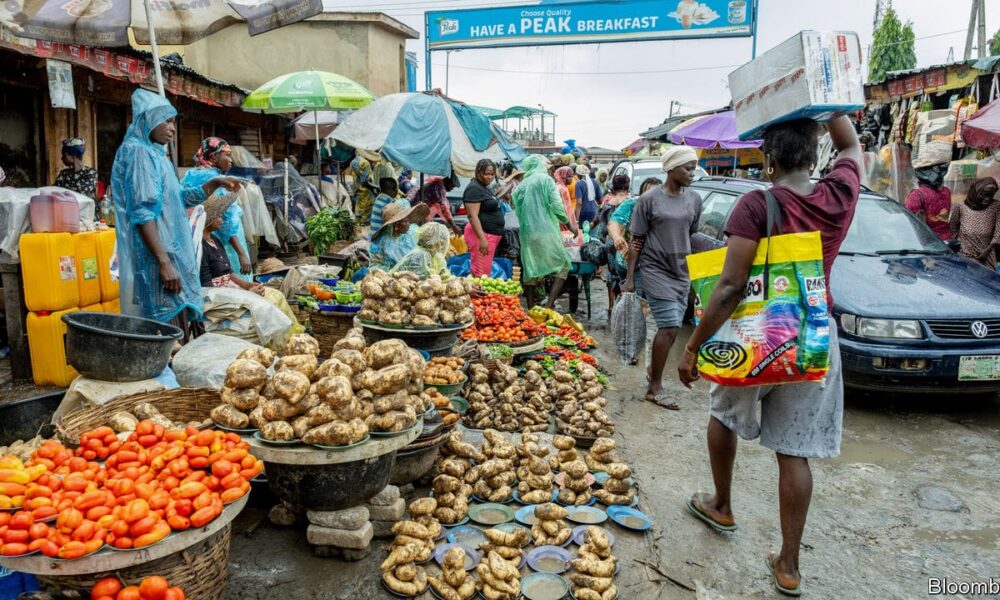




For years, the narrative of the Nigerian buyer was one of “resilience”, a word that often masked the pain of triple-digit inflation in key commodities and a volatile Naira. However, a longitudinal look at consumer sentiment from the harrowing lows of mid-2024 to the cautious optimism of early 2026 reveals a fundamental shift: Nigerians are no longer just “managing”; they are reorganizing the very DNA of consumption.

The numbers tell a story of hard-won stability. According to the Central Bank of Nigeria’s (CBN) December 2025 Household Expectations Survey, the Overall Consumer Sentiment index rose to 4.8 points, a significant leap from the pessimistic depths of 1.9 points just a month prior. Even more telling is the outlook for mid-2026, which sits at a robust 20.7 points.
This isn’t just “feeling good”; it’s the result of a grueling adaptation process. In 2024, when annual inflation peaked at nearly 35%, the Nigerian consumer responded with “substitution logic.” Premium brands were swapped for “Value Brands,” and the “Sachet Economy”, packaging products in tiny, affordable units, became the lifeblood of the FMCG (Fast-Moving Consumer Goods) sector.
By 2026, the IMF and local analysts project inflation to moderate further toward 12.9%, but the habits formed during the “Great Squeeze” have stuck. The consumer of 2026 is digitally-led and value-obsessed.
Market experts suggest that the Nigerian buyer has become one of the most discerning in the world. Dr. Paul Alaje, Chief Economist at SPM Professionals, notes that while the “thief in the night” (inflation) eroded savings, it also birthed a new era of financial discipline.
“We are seeing a ‘Productivity Channel’ opening up,” Alaje explains. “Consumers are linking their spending to income more strictly than ever. High-value purchases like real estate and cars remain in the negative index because Nigerians are prioritizing ‘Economic Conditions’ and ‘Family Financial Situations’ over luxury.”
Meanwhile, NielsenIQ (NIQ) analysts describe the 2026 consumer as “numb to volatility.” This isn’t apathy; it’s a high tolerance for risk that allows them to remain confident even when the macro-economy is in flux. They have mastered the “ROPO” effect, Research Online, Purchase Offline.
The longitudinal data identifies three distinct tiers of buying behavior that now dominate the landscape:
The Rational Mass Market: Focused on “unit sachets” and “refill packs.” This group treats daily meals as a “calculated sacrifice” and values functional utility over brand name.
The Digital Gen-Z & Millennial Cohort: Making up 70% of the population, this group drives “Social Commerce.” They buy via WhatsApp, TikTok Shop, and Instagram. For them, authenticity is the new currency.
The “Aspirational Afropolitan”: Despite the squeeze, this group seeks “affordable luxury.” They want quality signals—fortified foods, natural skincare, and “clean labels”—but at a price point that reflects the new reality.
For brand owners and handlers, the “old ways” of massive billboards and generic “quality” claims are dead. To reposition a brand in 2026, the strategy must be surgical:
Brands must offer “affordable effectiveness.” A product shouldn’t just be cheap; it must solve a problem better than the unbranded alternative.
The Sachet 2.0 Strategy: It’s no longer just about milk and detergent. Brands in electronics, beauty, and even “Buy Now, Pay Later” (BNPL) services are breaking down costs into bite-sized, digestible payments.
Hyper-Localization and Trust: In an era of “fake news” and “hidden charges,” transparency has become a competitive advantage. Brands that use clear, honest data and culturally resonant storytelling (leveraging micro-influencers over mega-stars) are winning.
Omnichannel Agility: As the digital economy approaches a $20 billion valuation, a brand must be as easy to find on a WhatsApp status as it is on a supermarket shelf.
The Nigerian consumer of 2026 is a survivor who has graduated into a strategist. They are optimistic, but their optimism is grounded in data, peer reviews, and price comparisons. For brands, the message is clear: the Nigerian buyer is no longer a passive target; they are an active partner. Those who respect their intelligence and meet them at the intersection of value and digital convenience will not just survive this cycle—they will define the next one.