

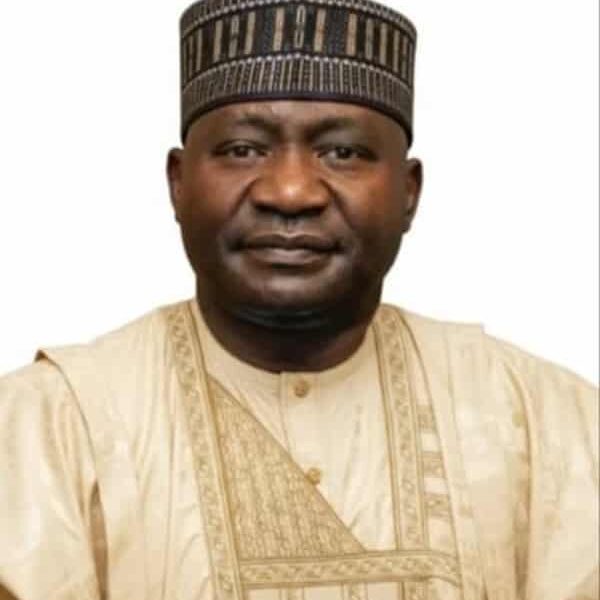




Kennedy Elaigwu Awodi

In national governance, few portfolios carry as much historical weight and immediate urgency as the Ministry of Defence. For decades, Nigeria’s defence strategy was defined primarily by tactical, reactive operations, a continuous cycle of deployment aimed at quelling operational fires across regions plagued by insurgency, banditry, and maritime piracy.

Yet, true national security demands far more than battlefield responsiveness; it requires systemic vision, structural self-reliance, and an intellectual foundation capable of adapting to complex, evolving threats. Over the past week, the Minister of Defence, General Christopher Gwabin Musa (Rtd), demonstrated that he possesses precisely this holistic vision, orchestrating a series of strategic milestones that promise to reshape Nigeria’s defence landscape for generations.
At the heart of General Musa’s approach is a fundamental truth that many predecessors overlooked: a nation cannot guarantee its long-term sovereignty if its military capacity remains tethered to external supply chains. During the inaugural Africa Defence Exhibition and Conference (AFRIDEX 2026) in Lagos, General Musa articulated a bold vision for domestic defence manufacturing. Moving beyond traditional rhetoric, the Ministry unveiled tangible roadmaps for indigenous military industrialization.
Under his leadership, Nigeria is transitioning from merely assembling basic equipment to preparing for the domestic production of Main Battle Tanks (MBTs), Armoured Personnel Carriers , high-grade ammunition, and advanced unmanned aerial vehicles (drones) through revitalized partnerships with the Defence Industries Corporation of Nigeria (DICON) and industrial collaborators like DICON D7G.
This shift toward localized military manufacturing is not merely an exercise in national pride; it is an economic and operational imperative. By establishing indigenous production facilities and infrastructure, such as the forthcoming military jetty in Lagos, Nigeria reduces its vulnerability to international arms embargoes, foreign exchange volatility, and supply chain disruptions.
Furthermore, General Musa’s framework positions Nigeria not just as a consumer of global defence tech, but as an export hub supplying military hardware across the African continent. This approach asserts Nigeria’s rightful role as a regional anchor while stimulating domestic industrial growth, creating specialized technological jobs, and keeping defense capital circulating within the local economy.
However, kinetic hardware and industrial capacity are only half of the modern defense equation. Recognizing that 21st-century warfare is increasingly asymmetrical, digital, and ideological, General Musa has pushed to bridge the gap between defense policy and intellectual rigor. His recent commissioning of the CG Musa Security Management Hub at the University of Ibadan represents a landmark initiative in civil-military collaboration.
For too long, policy formulation and academic research in Nigeria operated in isolated silos. By embedding research hubs within tertiary institutions, General Musa is creating an ecosystem where evidence-based research, strategic policy analysis, and advanced technological concepts feed directly into the operational planning of security agencies.
This institutional bridge addresses security challenges at their root. Understanding the socio-economic drivers of conflict, the mechanics of online radicalization, and the geopolitical dynamics of regional instability requires sophisticated scholarship. By establishing a dedicated hub for strategic dialogue, the Defence Minister is ensuring that the Armed Forces are backed by robust intellectual infrastructure. It is a doctrine of a “whole-of-nation” approach, signaling that security is not solely the responsibility of uniform-wearing personnel, but a collective effort involving scholars, technologists, and policymakers working in unison.
Beyond national borders, General Musa’s leadership over the past week has projected Nigeria’s strategic leadership onto the continental stage. His keynote interventions at AFRIDEX 2026 called on African nations to dismantle their systemic dependence on foreign defense manufacturers and build a unified, self-reliant defense architecture. By advocating for an operationalized African Standby Force (ASF), enhanced Gulf of Guinea maritime domain awareness, and structured follow-up mechanisms for continental military training, General Musa demonstrated statesmen-level diplomacy.
He framed African security not as a fragmented set of national problems, but as a shared responsibility best met through collective resolve and localized innovation.
Leadership in high-stakes public service is ultimately judged by the direction of travel.
In General Christopher Musa, Nigeria possesses a Defence Minister who combines deep operational experience from his tenure as Chief of Defence Staff with the progressive vision required of an executive policymaker. He understands that buying weapons buys time, but building industries, institutional capacity, and intellectual frameworks builds lasting security.
The developments of this past week reveal a Ministry of Defence operating with renewed clarity of purpose. By aligning defense capability with local manufacturing, academic partnership, and pan-African cooperation, General Musa is setting a benchmark for strategic governance. As these initiatives take root—from local assembly lines to university research centers—Nigeria moves closer to a future defined not just by the management of security threats, but by absolute operational sovereignty and enduring national peace.
Kennedy Elaigwu Awodi wrote from North Carolina, USA.
Email: awodiken@outlook.com