

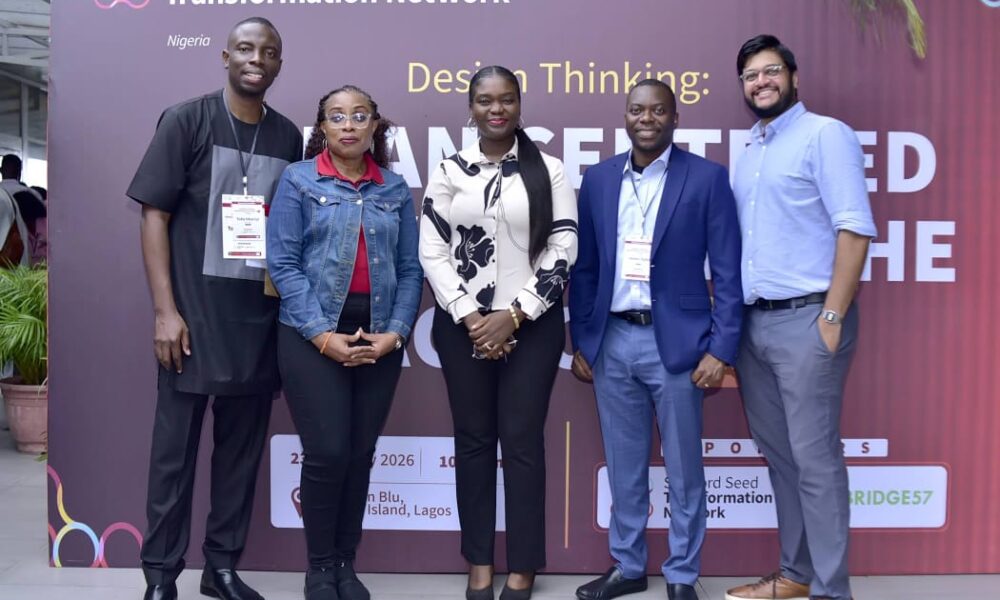



Seed Network Nigeria successfully hosted an exclusive workshop on Design Thinking: Human-Centered Innovation in the Age of AI, bringing together over 100 participants, including Seed members, their leadership teams, and guests, for a highly engaging learning experience facilitated by Rajan Patel, Director of Entrepreneurship and Management Programs at Stanford Seed.

The workshop formed part of Stanford Seed’s global engagement with its chapters, as Rajan Patel visited Seed networks to equip entrepreneurs and business leaders with practical approaches to innovation, leadership, and the effective application of Artificial Intelligence.

The event commenced with opening remarks from Toba Obaniyi, Communications Secretary of Seed Network Nigeria, who welcomed participants and provided an overview of the day’s objectives and expected outcomes. Also in attendance were Kate Selby, Network Administrator at Stanford Seed West Africa, and Folasade Ajdua-Frances, Business Transformation Advisor at Stanford Seed, who joined participants throughout the learning experience.
Throughout the workshop, Rajan Patel challenged participants to rethink the role of Artificial Intelligence in business, emphasizing that while AI is transforming industries and redefining how organizations operate, “it’s all about the people.” He encouraged business leaders to place empathy, customer understanding, and human needs at the heart of innovation, reminding participants that successful organizations focus on understanding people before building solutions.
Designed as a practical, hands-on experience, the workshop challenged participants to move beyond theory. Business leaders and their teams worked collaboratively to develop effective AI prompts, experiment with emerging AI tools, and create applications tailored to the specific needs of their businesses using AI-powered platforms introduced during the session. Through Stanford Seed’s Design Thinking approach of “Listen. Think. Build.”, participants learned that innovation begins with listening deeply, thinking critically, and continuously testing ideas.
A key takeaway from the workshop was the importance of experimentation. Rajan encouraged participants to embrace curiosity, continually test new tools, and view failure as an opportunity to learn rather than something to avoid. The session reinforced that Artificial Intelligence is here to stay, and organizations that intentionally explore and apply these technologies will be better positioned to innovate and remain competitive. Participants were also reminded that “prompting is key,” highlighting the importance of asking better questions to unlock better outcomes from AI.
One of the day’s highlights was the collaborative practical session, where participants worked in teams to solve business challenges, exchange ideas, and apply newly acquired concepts in real time. The highly interactive exercises reflected Stanford Seed’s experiential learning approach, enabling participants to leave with practical frameworks and actionable strategies they could immediately implement within their organizations.
The workshop also received support from Roseline Ilori, Founder of Bridge 57 Solutions and a member of Seed Network Nigeria, who sponsored the event and attended alongside members of her team.
The workshop concluded with participants leaving equipped with practical tools, fresh perspectives, and renewed confidence to leverage Design Thinking and Artificial Intelligence to drive innovation, solve business challenges, and create lasting value within their organizations. Rajan closed the session by reminding participants that “Leadership is the act of mobilizing people towards a common purpose,” reinforcing that technology is most impactful when guided by purposeful leadership.
Through initiatives such as this, Seed Network Nigeria continues to provide business leaders with access to world-class learning experiences that strengthen leadership capacity, foster innovation, and prepare entrepreneurs to thrive in an increasingly AI-driven economy.