

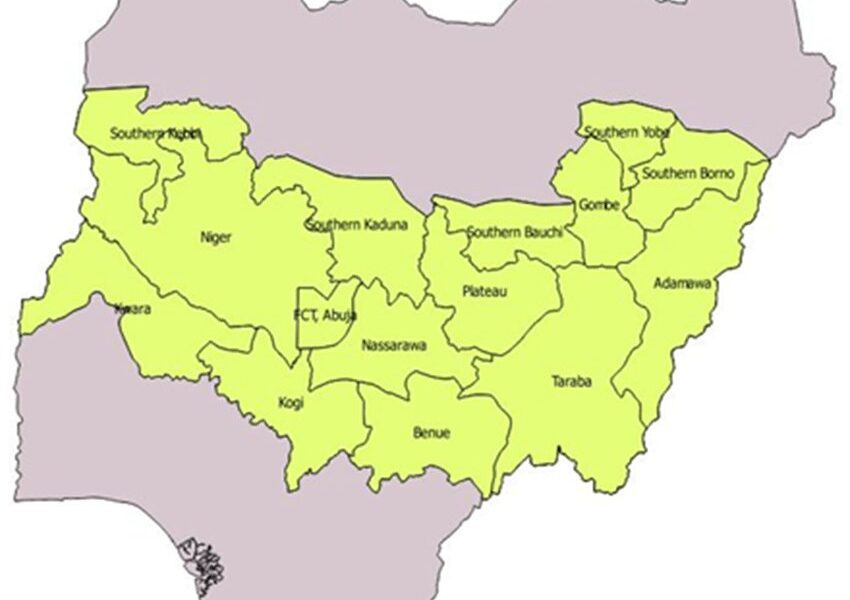



As I survey the historical landscape of the Middle Belt and the broader Nigerian project, I am often struck by a profound silence, a silence that many mistake for absence. It is the silence of the Kwararafa Kingdom. To the casual observer or the modern-day revisionist, Kwararafa is a ghost of the 17th century, a footnote in a textbook. But to those of us who carry the blood of its warriors and the memory of its defiance, Kwararafa is not a ghost; it is a foundation.

Before I address the future, I must ground us in the past. The Kwararafa Confederacy was not your typical centralized monarchy; it was a sophisticated, multi-ethnic powerhouse centered primarily around the Jukun people, but it was far more than a single tribe. It was a grand alliance, a “confederacy” in the truest sense, binding together groups like the, Idoma, Igala, Ebira, Afizere, Tarok, Goemai, and even parts of the Kanuri and Nupe.

At its zenith, Kwararafa was the only power south of the Sahara that struck terror into the hearts of the great Hausa States of the north. From our capital at Biepi (and later Wukari), our armies marched on Kano, Katsina, and Zaria. We didn’t fight for religious conversion or territorial enslavement; we fought for the preservation of our autonomy and our spiritual heritage. We were the “Empire of the Sun,” a wall of resistance that stood firm while others crumbled.
The decline of Kwararafa was not a sudden collapse but a gradual fraying of the confederate threads, punctuated by the 1804 Jihad. I find it necessary to address the descendants of the 1804 marauders who often speak as though history began and ended with their cavalry charges. There is a dangerous assumption in contemporary Nigerian politics that the “conquest” of the 19th century permanently erased the ancient boundaries of the Middle Belt.
Let me be clear: the 1804 movement may have disrupted our political structures, but it never conquered the Kwararafa soul. The marauders of that era may have planted flags, but they never uprooted the roots. If they concluded that this space, the lush valleys of the Benue and the highlands of the Plateaus, is theirs by right of ancient conquest, they have made a grave mathematical error in history. We, the descendants of the Kwararafa, are not only active; we are vigilant. We are following the trends of events in Nigeria with a keen, ancestral eye.
History is a wheel, not a straight line. To those who say a kingdom once fallen can never rise again, I point to the global stage. Consider Germany. Following the devastation of World War II, the nation was shattered, occupied, and split into East and West. Western Germany, in particular, had to rebuild from literal rubble. For decades, it was a fragmented shadow of its former potential.
Yet, look at Germany today. Through the Wirtschaftswunder (economic miracle) and a relentless commitment to identity and industry, it rose to become the engine of Europe. It proved that a people’s “statehood” is not dependent on a crown, but on their collective will.
Kwararafa shares this “Phoenix Principle.” We have seen kingdoms rise, fall, and rise again in different forms. The Jukun-led confederacy may not return as a pre-colonial military state, but it is rising today as a socio-political bloc. The shared identity of the “Kwararafa descendants” is becoming the most potent political currency in the Nigerian Middle Belt.
When I speak of the rise of Kwararafa in the 21st century, I am not calling for spears and shields. I am calling for the intellectual and economic reunification of our people. The “Confederacy” today exists in the shared grievances and the shared aspirations of the peoples of Taraba, Benue, Nasarawa, Plateau, Kogi, Adamawa, Niger,, and Gombe.
We are witnessing a spiritual awakening. The descendants of the Jukun, the Idoma, and others are realizing that our ancestors’ strength lay in their diversity. Just as the original Kwararafa was a coalition of different tongues unified by a common purpose, the modern Kwararafa must be a coalition of modern professionals, politicians, and thinkers.
We are watching the “trends of events”, the shifts in security, the debates over land rights, and the restructuring of the Nigerian federation. We are no longer the “silent minority.” We are the bridge between the North and the South, and we are rediscovering that the bridge is actually the foundation.
To the skeptics, I say: do not mistake our patience for weakness. The fall of the physical walls of Biepi did not mean the end of the Kwararafa dream. We have lived through centuries of pressure, yet our languages, our cultures, and our fierce independence remain intact.
The marauders of the past and the political hegemonists of the present should take note. The space we occupy is not a vacuum waiting to be filled; it is an ancestral home being renovated. We are leaning into our history, not to live in the past, but to secure a future where the Middle Belt is the arbiter of its own destiny.
The Kwararafa Kingdom is rising again, not in the smoke of battle, but in the fire of consciousness. We are here, we are active, and we remember who we are.
Comrade Godwin Anyebe is a Journalist and a Rights Activist.