


Artificial intelligence is shaping Africa’s energy systems more than most realise. From predictive maintenance tools powering mini-grids in Kenya to demand-forecasting models used by Nigeria’s distribution companies, AI is already making decisions that influence who gets power, when, and at what cost. Satellite-powered mapping guides governments on where the next solar hub should go but this intelligence is concentrated, accessible mostly to those already in the system.

The precision excites me: for the first time, we can close the data gap that has punished the continent for decades. AI can show us where energy poverty is deepest, where losses occur, and where investments must flow. But that same precision worries me. Precision without accountability risks automating inequality. If algorithms are trained on biased or incomplete data which is often the case, African communities risk exclusion.

In Africa, the question is not, “Is the technology good?” It is, “Who does it serve, and who does it leave behind?” When algorithms decide who receives electricity, subsidies, or infrastructure upgrades, we risk turning an essential public good into mathematical gatekeeping. A system that prioritises customers with steady incomes, strong digital footprints, or formal addresses makes the invisible even more invisible and invisibility always becomes exclusion.
Digital colonialism compounds the danger: foreign companies building AI tools that govern African energy choices without understanding local social realities. Black-box automation leaves communities powerless to question, appeal, or challenge decisions. My deepest fear is a future where energy inequality is created not by politics, but by code and code has no empathy.
Ethical AI must be rooted in an African context. You cannot design a rural Enugu algorithm using data from downtown Vancouver. Indigenous knowledge teaches what AI often lacks: context, community, and continuity. Traditional custodians understand land, seasonal shifts, water flows, wind behaviour, and social systems determining energy access not just production. Energy is not just infrastructure; it is a relationship.
Embedding that worldview into AI systems shifts design from extraction to stewardship.
It forces us to ask questions technology often ignores: How does this innovation honour people? Protect the land? Safeguard future generations? This is the ethical grounding AI desperately needs.
Justice in AI governance rests on three pillars. First, transparency: no algorithm should allocate energy without clear explanations. Communities must understand decisions rooted in logic, not secrecy. Second, participation: Africans must be at the table. Local engineers, regulators, Indigenous leaders, gender experts, lawyers, rural users those impacted must shape the rules. Third, accountability: responsibility must be clear when systems fail.
If a village loses power for ten days, who fixes it? Who compensates? Who audits the algorithm? A fair system treats energy as a human right and AI as a servant, not an oracle.
When I picture Africa’s energy future in 2030, I see a continent powered by intelligence, human and technological. A grid that predicts storms before lines fail. A system decentralised enough that a child in rural Enugu has the same access as a student in Johannesburg. Transparency replaces guesswork. AI supports planning. Communities understand decisions.
But the vision is also rooted in dignity. Solar hubs powering schools. Farmers charging irrigation pumps with clean energy. Women leading local cooperatives. Communities becoming energy sovereign. No girl walking kilometres just to read by candlelight. A smart, just, resilient grid designed with her in mind.
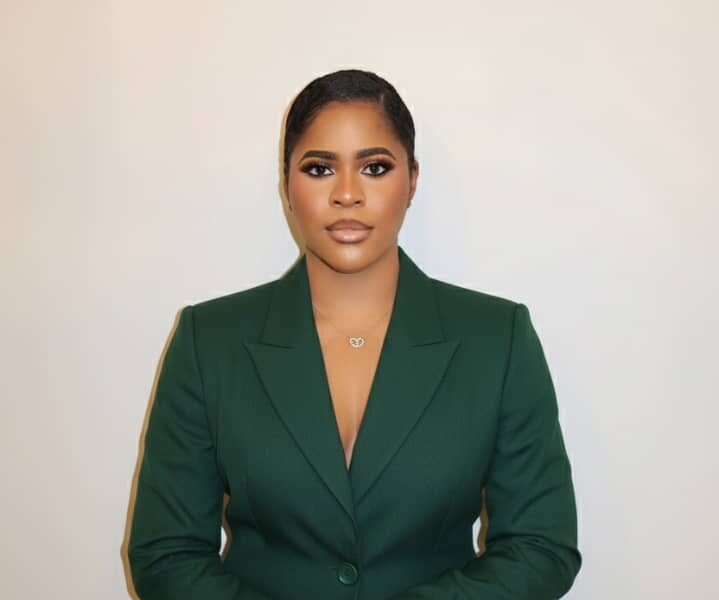
AI can help us build this future but only if the people shaping the technology are as inclusive as the future we imagine. Summer Okibe is a climate and energy policy specialist, attorney, and doctoral researcher currently based in Canada. As a voice for inclusive and sustainable development, she combines academic rigor
with grassroots impact, having secured over $400,000 in scholarships and disbursed funds to less-privileged children across Nigeria.
She is currently developing the concept of Aderayah Academy, a vision for a tuition-free, solar-powered school in Enugu designed to give underserved children access to quality education. In addition, she recently launched a ₦500,000 annual prize for outstanding female law graduates at Chukwuemeka Odumegwu Ojukwu University (COOU).
Recognized with awards including the Flight 302 Legacy Award and JCI Top 100 Outstanding Young Persons of Nigeria, Summer’s leadership inspires youth across the continent.