




By Kennedy Elaigwu Awodi

As I watched the high-level panel discussions in Lagos recently, surrounded by the hum of private sector titans, international development partners, and policy experts, I felt a rare sense of pragmatic optimism. For too long, the conversation around Nigeria’s Internally Displaced Persons (IDPs) has been trapped in a cycle of “emergency thinking”, a perpetual loop of food drops and temporary shelters that treats a chronic developmental wound with a recurring bandage.
However, listening to Dr. Bernard Doro, the Minister of Humanitarian Affairs and Poverty Reduction, it is clear that the tide is finally turning. The “Lagos Consensus” emerging from these sessions, particularly the panel on “Scaling Impact and Building Resilience: Innovative Financing & De-risking,” marks a sophisticated departure from the status quo.
I believe we are witnessing the emergence of a leader who understands that you cannot “charity” your way out of a displacement crisis affecting 3.7 million people. You must “invest” your way out.
One of the most striking attributes of Minister Doro is his refusal to engage in the “politics of timelines.” When pressed recently on ARISE NEWS about exactly when the camps would be empty, his response was refreshing in its honesty. He didn’t offer a hollow “six-month” promise to win a news cycle. Instead, he mapped out the complexity of a multifactorial crisis, from conflict to climate change, and insisted on building sustainable infrastructure over making superficial claims.
This candor is his greatest strength. By acknowledging that displacement is as much an economic issue as it is a humanitarian one, Doro is speaking the language of the Developmental Partners we so desperately need to keep at the table. He isn’t just asking for aid; he is pitching a value proposition.
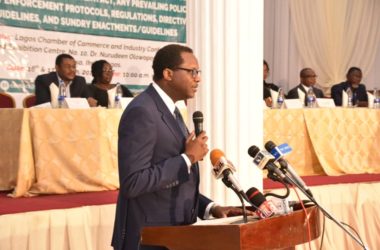
During the high-level panel I observed, titled “Scaling Impact and Building Resilience: Innovative Financing & De-risking,” held between 8:45 and 10:00 AM on Thursday, last week, Doro demonstrated his ability to bridge the gap between government mandate and private sector logic.
The panel wasn’t just another talk shop. It was a strategic session focused on:
Innovative Financing: Moving beyond budgetary allocations to find blended finance models.
De-risking: How the government can provide the security and policy guarantees necessary for the private sector to enter displacement corridors.
Market-Based Solutions: Transitioning from “Humanitarian Response” to “Investment & Jobs.”
I saw a Minister who didn’t just sit on the stage to deliver a keynote and leave. He engaged deeply with the UK International Development teams, the United Nations representatives, and private conglomerates like TGI. He understands that to resettle Nigerians in the Northeast, Northwest, and North Central, we must create “Reconstruction-to-Resilience Value Chains.”
What impressed me most was the granular focus on the three regional “Action Tracks” discussed during the sessions:
Track Focus Area Doro’s Strategic Aim
Track 1: Northeast Reconstruction-to-Resilience Turning aid recipients into workers in local value chains.
Track 2: Northwest Competitive Advantages Identifying priority sectors that can thrive despite past instability.
Track 3: North Central Inclusive Value Chains Ensuring that resettlement includes the most vulnerable: women and girls.
By breaking the problem down into these specific geographic and economic units, Doro is making the IDP crisis “solvable” in segments. He is moving away from the monolithic “IDP problem” toward a localized “Economic Opportunity” model.
Doro’s philosophy, which I have heard him articulate with increasing passion, is the concept of “Graduation.” It is the idea that while we must meet the immediate humanitarian needs of those in the camps, the ultimate goal is to graduate them into a path of resilience and independence.
As he noted during his sessions on Financial Inclusion and Digital Connectivity, a displaced person with a bank account and a digital skill is no longer a “victim” to be managed; they are a citizen to be integrated. This is the “Doro Method”: using technology and financial tools to leapfrog the traditional hurdles of resettlement.
In my view, Bernard Doro represents the “New Guard” of Nigerian governance. He possesses a rare blend of empathy, manifested in his concern for the daily welfare of those in the camps, and a cold, analytical eye for systemic efficiency. He is working with the private sector not because it’s a buzzword, but because he knows the government cannot do it alone.
He is building homes where the crisis has abated, but more importantly, he is building the economic ecosystems that will make those homes worth living in. He is inviting the private sector to see displacement corridors not as “no-go zones,” but as frontiers for agribusiness, local enterprise, and job creation.
The road ahead is undeniably steep. With 3.7 million souls looking for a way home, the pressure is immense. Yet, for the first time in a long time, I see a framework that makes sense. I see a Minister who has the ear of the President and the respect of the international community.
I believe that if we follow the roadmap laid out in the Lagos high-level panels, prioritizing market-based solutions and de-risking the North, we will see the “resilience” we often talk about become a lived reality for millions of Nigerians. Bernard Doro isn’t just managing a crisis; he is architecting a recovery. And that is exactly the kind of strength Nigeria needs right now.
Kennedy Elaigwu Awodi wrote from North Carolina, USA.
Email: awodiken@outlook.com