



By the Investigative Unit of Consumers Assembly

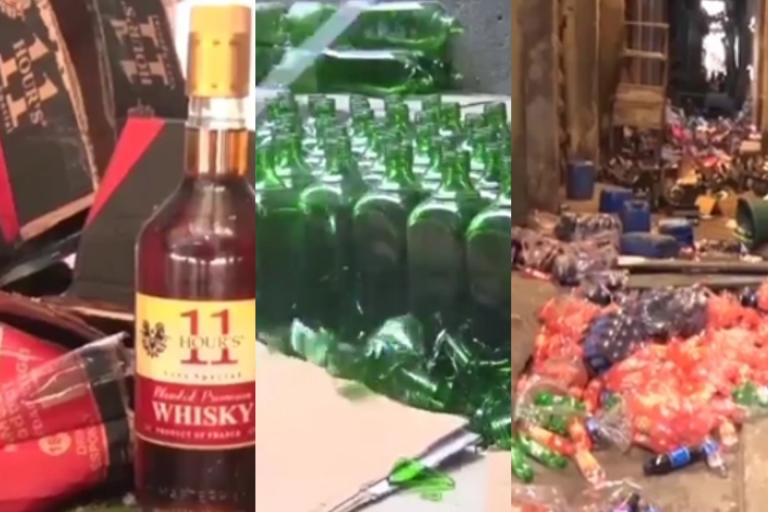
A three-month undercover investigation by the Consumers Assembly has uncovered a thriving hub of industrial-scale criminality within the Ojo Barracks axis of Lagos State. Operating under the shadows of residential and semi-commercial structures, dozens of illegal factories are mass-producing counterfeit wines, whiskies, perfumes, and body creams.

These entities, which are neither registered with the Corporate Affairs Commission (CAC) nor certified by the National Agency for Food and Drug Administration and Control (NAFDAC), are pumping lethal concoctions into the Nigerian market.
Our investigation reveals a horrifying breach of human dignity, where workers, many of them undocumented and underpaid, toil in unsanitary conditions to produce “slow poison” for an unsuspecting public. We call upon the Federal Government, NAFDAC, and the Nigerian Police to immediately dismantle these syndicates and prosecute the perpetrators.
For years, the Ojo area has whispered secrets of “backyard brewing,” but our findings suggest the scale has evolved into a sophisticated industrial menace. Our undercover investigators gained access to three separate “production lines” operating behind high walls and nondescript gates near the barracks.
In one facility, our team witnessed the “brewing” of premium-label Scotch whisky. There were no distillation columns or quality control labs. Instead, large plastic drums were filled with industrial ethanol, brown food coloring, and artificial flavorings. The liquid was stirred with wooden planks, siphoned into recycled original bottles collected from scavengers, and sealed with counterfeit tax stamps and foil caps.
The cosmetics wing of this illegal hub is equally alarming. Body creams, marketed as “lightening” or “rejuvenating,” are mixed in rusted basins using banned substances such as high-concentration hydroquinone and mercury. The perfumes, packaged in bottles mimicking luxury global brands, are primarily composed of methanol, a substance that can cause severe respiratory distress and skin burns.
The environment inside these factories is a direct affront to human rights. Workers operate without gloves, masks, or protective gear, breathing in concentrated chemical fumes for 12 hours a day. One worker, speaking on condition of anonymity, stated:
”We know what we are making is bad. My skin is peeling from the cream mixing, and sometimes the ethanol fumes make us faint. But the bosses tell us that if we talk, we will lose our jobs or worse.”
The “savings” consumers think they make by buying these cheaper alternatives come at a heavy biological cost. Illegal spirits often contain Methanol instead of Ethanol. While ethanol is the alcohol found in legitimate drinks, methanol is a wood alcohol used in antifreeze. When ingested, the body metabolizes methanol into formaldehyde and formic acid.
This attacks the optic nerve, leading to permanent blindness, and causes metabolic acidosis, which leads to kidney failure and death. Substandard creams often hide heavy metals. According to the World Health Organization (WHO), mercury in skin-lightening products can lead to: Kidney damage, skin rashes and scarring, reduction in the skin’s resistance to bacterial and fungal infections.
Brand Victims: The Global and Local War on Fakery
Fakery is not a “Nigerian problem” alone; it is a global epidemic that devalues legitimate businesses and kills consumer trust. In Nigeria, several household names have fought grueling battles against counterfeiters. For example, Chelsea Dry Gin: Once a victim of massive local cloning, the brand had to introduce sophisticated tamper-proof caps and “scratch-to-verify” codes.
Peak Milk: NAFDAC has previously raided markets in Aba and Lagos where counterfeiters were re-bagging expired or industrial-grade milk powder into counterfeit Peak sachets.
My Pikin Baby Teething Mixture: A tragic historical example where a substandard formulation containing diethylene glycol killed 84 children in Nigeria.
Global Casualties
Hennessy and Johnnie Walker: These luxury spirit brands are the most counterfeited globally. In China and Eastern Europe, “refilling” syndicates operate similarly to the Ojo ring, using genuine bottles but toxic liquid.
Louis Vuitton and Estée Lauder: In the luxury and beauty sectors, these brands lose billions annually to counterfeiters. In 2022, Europol seized over €166 million worth of counterfeit goods, including fake perfumes that contained traces of human urine as a “stabilizer.”
Why the Wickedness?
The user asks: Why would a human being be this wicked to his fellow human? Psychologically, this behavior stems from Moral Disengagement. Perpetrators of counterfeit manufacturing view their victims not as people, but as “faceless statistics.” To them, the “uncontrollable appetite for money” creates a tunnel vision where the profit margin justifies the mortality rate. They operate on a “predatory economic model,” thriving in environments where poverty makes consumers price-sensitive and where enforcement is perceived as weak.
The recurrence of illegal activities in Ojo, despite previous raids, suggests that “occasional stings” are not enough. We need a systemic overhaul. NAFDAC and the Police should establish a joint task force with a permanent station in the Ojo/Alaba axis to monitor industrial movements.
The current fines for producing fake products are often seen as a “tax on business.” We need mandatory long-term jail sentences without the option of a fine for those operating illegal factories.
The government must mandate the use of Blockchain-based tracking or Mobile Authentication Service (MAS) for all alcoholic beverages and high-end cosmetics, not just pharmaceuticals.
Government should create a secure, incentivized channel for factory workers to report illegal operations without fear of retribution.
For the Consumer: How to Stay Safe
If a bottle of premium whisky that usually costs ₦45,000 is being sold for ₦15,000 in a “clearance sale,” it is almost certainly fake. Inspect the Packaging: Look for spelling errors, blurry printing on labels, or “loose” caps. Real brands have high-precision packaging.
Check the NAFDAC Number: Use the NAFDAC website or SMS verification services where available.
Smell and Texture: If a perfume smells overwhelmingly of chemicals or a cream has a gritty, uneven texture, discard it immediately.
Conclusion
The Ojo Barracks factories are not just businesses; they are crime scenes in progress. Every bottle of fake gin and every jar of toxic cream produced there is a potential death sentence for a Nigerian citizen. We call on the Director-General of NAFDAC and the Lagos State Commissioner of Police to move beyond rhetoric and shut down these death chambers for good. Nigerians deserve to live. They deserve to consume what they pay for without fear.