
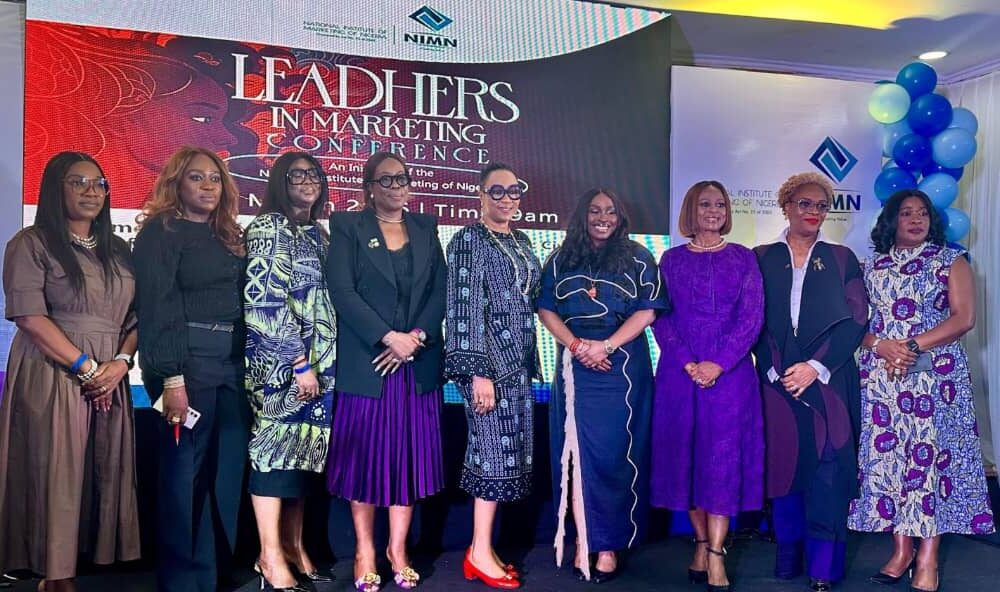


The atmosphere at the Civic Centre in Victoria Island, Lagos, recently, was more than just professional; it was electric. Beneath the sophisticated backdrop of one of Nigeria’s premier event venues, a shift was occurring, a quiet but firm tectonic movement in the landscape of Nigerian commerce.
The National Institute of Marketing of Nigeria (NIMN) was hosting its maiden LeadHers in Marketing Conference. This wasn’t just another industry gathering; it was a manifesto for the future. With the theme “Redefining Influence: Women Shaping the Future of Marketing,” the conference served as a clarion call for women to move from the periphery of execution to the very center of strategic architecture.
Dr. Bolajoko Bayo-Ajayi, the President of NIMN, set the tone with a welcome address that was both a celebration and a challenge. To her, the “LeadHers” initiative is a transformative platform designed to amplify voices that have long been the backbone of the industry but perhaps not always its face.
“Today marks the beginning of a new chapter,” she declared, her voice resonating with the weight of the moment. “Influence in our profession is evolving. It’s moving beyond traditional metrics like reach and visibility. Today, it’s about authenticity, trust, and meaningful engagement.”
She poignantly noted that women are no longer just participants in the marketing ecosystem; they are becoming its architects. By bringing empathy, nuanced storytelling, and innovation into brand strategy, women are redefining what it means to connect a product with a human being.
When Folashade Ambrose-Medebem, the Lagos State Commissioner for Commerce, Cooperatives, Trade and Investment, took the stage, she brought the cold, hard numbers that make the case for female leadership undeniable.
She reminded the audience of a staggering global reality: women drive between 70% and 80% of all consumer purchasing decisions. “When the people shaping demand are also shaping the narratives behind brands, industries become more responsive, inclusive, and innovative,” Ambrose-Medebem noted.
In Nigeria, the stakes are even higher. With women owning approximately 40% of Micro, Small, and Medium Enterprises (MSMEs), the engine room of the Nigerian economy, female influence isn’t just a “diversity goal”; it is a strategic economic imperative.
The Commissioner emphasized that under the T.H.E.M.E.S+ Development Agenda of Governor Babajide Sanwo-Olu, Lagos is intentionally positioning women in key governance and professional roles to ensure the state remains the commercial nerve center of Africa.
If the Commissioner provided the data, the keynote speaker, Osayi Alile, provided the fire. Her message was a direct strike at a common psychological hurdle: the “waiting for permission” syndrome.
Alile challenged the women in the room to stop waiting until they felt “overqualified” before stepping into leadership roles. “Many women delay opportunities while trying to become perfect,” she warned. “This habit limits growth. The landscape, driven by AI, data, and rapidly shifting consumer behavior, requires us to assert our expertise confidently.”
Her message was clear: Representation isn’t just about having a seat at the table; it’s about ensuring that when women influence storytelling, the resulting brand narratives are reflective of the actual society we live in.
The panel session, moderated by Chizor Malize, MD/CEO of FITC, dived deep into the mechanics of influence in the digital era. The panelists, Onyinye Ikenna-Emeka (CMO, MTN), Chioma Afe (Director, Seplat), and Adebola Williams (Marketing Director, Promasidor), unpacked the concept of “Relational Intelligence.”
They argued that in 2026, influence is no longer defined by how loud a brand can shout through advertising. Instead, it’s about:
Meaningful Connection: Delivering real value beyond the transaction, Courageous Leadership: Making tough calls that align with brand values, Stakeholder Balancing: Managing the delicate dance between business goals, community needs, and regulatory environments.
The consensus was clear: Visibility without authenticity is a wasting asset. To lead the future of marketing, women must leverage their innate ability to build trust—the most valuable currency in a digital-first world.
Perhaps the most relatable moment of the day came during the fireside chat with Folake Soetan, CEO of Ikeja Electric Plc, moderated by Tosin Adefeko. Soetan’s journey is a masterclass in “value-addition” leadership.
“I started as a call center agent in the aviation industry,” Soetan shared, a revelation that hushed the room. “From there, I moved to Oil and Gas, and now the power sector. For everything I have done, it has never been about the title; it has been about how things work and how I can add value.”
Soetan addressed the “digital influence” elephant in the room. Like many executives, she had kept her social media private for years, thinking she was protecting her privacy. “I didn’t realize I was limiting my brand visibility,” she admitted.
Today, she views digital presence as a necessity for modern leaders. When leaders are accessible online, it humanizes the organization and provides a roadmap for the younger generation. Her mantra for 2026? Be intentional. Every post, every insight shared, should be aimed at influencing people positively while keeping competence as the bedrock of that visibility.
Recognizing that a high-flying career is unsustainable without physical well-being, the conference included a vital health awareness session by Nordica Fibroid Care Centre. The session served as a reminder that women’s health is the foundation upon which professional longevity is built. You cannot shape the future of an industry if you are not healthy enough to inhabit it.
As the event drew to a close, Thelma Okoh, the Registrar/Secretary to Council of NIMN, expressed her gratitude to the participants. She noted that the LeadHers conference is more than a one-off event; it is a strategic platform to empower the next generation and strengthen marketing’s role in national development.
The takeaway from the maiden LeadHers in Marketing Conference was profound. As Commissioner Ambrose-Medebem eloquently put it, the story of women in marketing is no longer about breaking glass ceilings, it is about designing entirely new skylines of leadership.