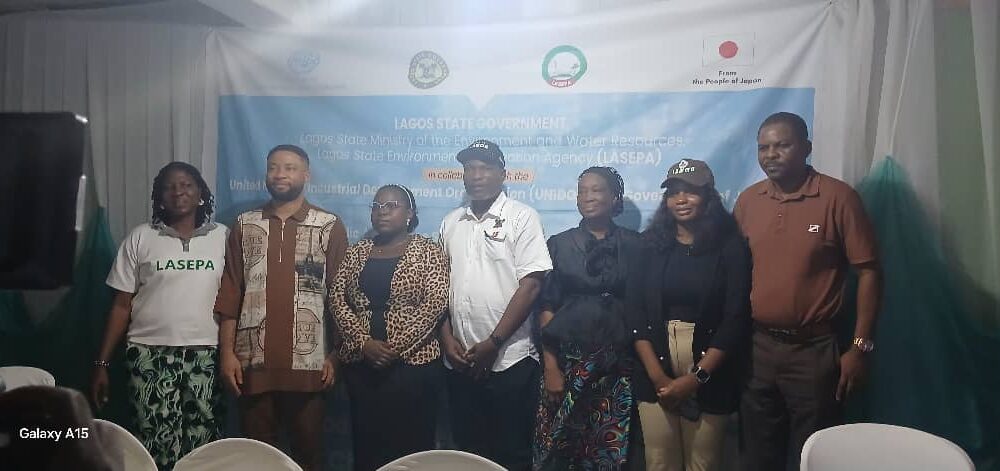


In a strategic move to fortify public health against the rising threats of climate change and waterborne diseases, the Lagos State Environmental Protection Agency (LASEPA), in collaboration with the United Nations Industrial Development Organization (UNIDO) and the Government of Japan, held an emergency capacity-building workshop today at the Ikeja Local Government Secretariat.

The intervention, titled “Good Practices for Food and Water Safety in Flood-Driven Areas: Combating Cholera Outbreaks,” specifically targeted informal food and water vendors, as well as waste workers, the frontline defenders of community hygiene in Lagos.
Representing the General Manager of LASEPA, Dr. Babatunde Ajayi, the Executive Assistant to the Governor on Environmental Protection, Mrs. Tolulope Adebowale, opened the event by emphasizing that advocacy is the first line of defense.
”This event is about the way forward in managing and preventing cholera,” Mrs. Adebowale stated. “Awareness is the first step in preventing an outbreak. It is our collective duty to prevent cholera in Lagos, and we expect every participant to take this message back to the grassroots.” She noted.
The initiative received strong praise from the Lagos State Ministry of Environment and Water Resources. Dr. Hassan Sanuth, representing the Water Resources department, noted that environmental health is inextricably linked to economic and social stability. “It is only when our neighbor is safe that we can truly be saved,” he remarked, thanking UNIDO and Japan for their consistent support.
The Lagos State Water Regulatory Commission (LASWARCO), represented by Mr. Lanre Owotoro on behalf of CEO Barrister Kadijat Adeyemo, highlighted the critical role of vendors. “Our responsibility is to ensure water used by households and vendors is safe. We recognize that food vendors, water vendors, and waste workers are at the frontline of our community,” he said.
Echoing this sentiment, the Chairman of Ikeja Local Government, Comrade Akeem Dauda (represented by Adeniyi Adeniyi), admonished participants to view environmental care as essential to human existence.
Providing the project overview, Charles Uzoma, UNIDO Field Coordinator, explained that the intervention was born out of the reality that cholera outbreaks in Nigeria have become almost yearly due to climate change.
”The objective is to build capacity to confront these outbreaks. Since we began last year, we have reached milestones in Ojo, Badagry, Ikorodu, and Lagos Island. Today in Ikeja, we continue our mission to reduce transmission and build community resilience,” Uzoma noted.
During the technical session, Dr. Hassan Sanuth, Director of Sanitation, revealed that the minimal records of cholera in Lagos during 2025 could be attributed to these ongoing awareness programs. He warned that the Vibrio cholerae bacteria could survive for up to 14 days even in dry conditions.
To combat the spread, especially during the “flash flooding” typical of Lagos, Dr. Sanuth outlined several Good Practices:
Water Safety: Always boil water from boreholes or wells before consumption.
Food Hygiene: Ensure food is prepared in hygienic environments; wash fruits thoroughly with clean water.
Personal Hygiene: Frequent handwashing and maintaining short, clean fingernails.
Environmental Management: Properly manage waste and immediately disinfect floors and surfaces affected by floodwaters.
The event concluded with a call for all attendees including students and waste managers, to act as ambassadors of hygiene within their various local communities.