




By Consumers Assembly Team

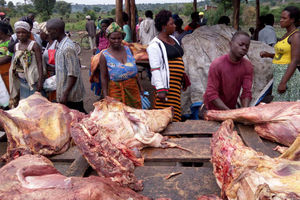
In the quiet dawn of a typical Thursday in Abesan Estate, the air should be crisp with the morning breeze. Instead, residents are increasingly greeted by the metallic tang of fresh blood and the harrowing cries of livestock. The same scene unfolds with alarming regularity in Giwa and Victor Fagbemi streets in Aboru, where residential gutters, designed for rainwater, now serve as makeshift flumes for animal offal and effluent.
A dedicated investigation by the Consumer Assembly Team, a news platform focused on consumer advocacy, has revealed a disturbing trend: the systematic conversion of residential streets into commercial abattoirs. What began as occasional backyard slaughtering for festive periods has morphed into a full-scale, daily commercial enterprise, posing a catastrophic threat to public health and the environment.
Is this Legal?
The short answer is a resounding no. In Lagos State, it is strictly illegal to butcher animals at random spots for commercial purposes. Under the Lagos State Meat Inspection Law and environmental sanitation regulations, animal slaughtering is confined to approved abattoirs and slaughter slabs.
The government’s stance is clear: commercial butchering in residential areas is a violation of land use laws and public health codes. Yet, the practice persists, fueled by a desire to evade the fees and oversight of regulated facilities.
Siting an abattoir is not merely about finding an empty plot of land; it requires rigorous environmental and veterinary assessment. David Obinna, an environmental safety consultant, emphasizes that the infrastructure required for safe butchering is entirely absent in residential neighborhoods.
”A standard abattoir requires specialized waste management systems to handle ‘red water’, the blood, and solid waste. When you butcher on a street in Abesan, that blood goes straight into the tiny drainages,” Obinna explains.
“These gutters are not designed for biological waste. The blood congeals, blocks the flow, and creates a ‘pathogen soup’ that seeps into the groundwater of neighboring houses.” He added.
His words: “a constant source of potable water is required for hygienic processing.To prevent the spread of zoonotic diseases and noise pollution, it is important for abattoirs to be away from residential areas.
Facilities must be accessible to veterinary inspectors and refrigerated transport vans.”
The Role of the Vet: Life and Death Oversight
Perhaps the most dangerous aspect of street butchering is the complete absence of professional oversight. In a regulated setting, every animal must undergo a “post-mortem” and, more importantly, an “ante-mortem” inspection.
Dr. Bunmi Olorunshogo, a seasoned Veterinary Doctor, warns that the lack of professional inspection in places like Giwa and Aboru is a ticking time bomb for the state’s health system.
”People don’t realize that a cow can look healthy but be carrying Tuberculosis, Anthrax, or Brucellosis,” Dr. Olorunshogo states. “My job is to examine the animal while it is still alive to check for clinical signs of disease and to ensure it hasn’t been recently treated with antibiotics. If we kill an animal in the middle of a street without a Vet’s clearance, we are essentially feeding the public poison.”
She further notes that the stress of being slaughtered in a chaotic, unoptimized environment causes the animal to release hormones that degrade meat quality and speed up spoilage, making the meat even more dangerous for the final consumer.
From Sacred to Profane
The concept of the abattoir dates back to the mid-19th century in Europe, specifically Paris, where “tueries” (private slaughterhouses) were consolidated into public facilities to centralize hygiene. In Nigeria, meat inspection laws were established as early as 1942, recognizing that the meat trade was a pillar of public safety.
In the early days of Lagos, the Oko-Oba Abattoir was envisioned as a state-of-the-art hub. However, as the population exploded, the gap between demand and regulated supply widened. This vacuum has been filled by “street butchers” who have discarded centuries of hygiene evolution for the sake of convenience and tax evasion.
The Lagos State Ministry of Agriculture and the Ministry of the Environment are certainly aware of the “street abattoir” phenomenon. In recent years, the state has intensified its “Monitoring, Enforcement, and Compliance” (MEC) operations.
However, residents feel the enforcement is too slow.
The Consumer Assembly Team has noted that while the state occasionally raids illegal slabs, the butchers often return within 48 hours. The blood-clogged gutters of Victor Fagbemi street remain a reflection of a system that is struggling to keep up with illegal urban farming and butchering.
The Invisible Threat to the Consumer
Street abattoirs are a multi-dimensional threat. Beyond the “unnecessary odour” that permeates the air in Aboru, there is the risk of secondary contamination. Meat processed on the bare floor is exposed to flies, dust, and rodents.
”The consumer is the biggest loser,” says David Obinna. “They think they are getting ‘fresh’ meat, but they are buying meat that has been washed with gutter-adjacent water and handled by people with no training in food safety.”
The conversion of Abesan, Giwa, and Victor Fagbemi into slaughter zones is a regression of urban civilization. It is a crisis where the search for “cheap meat” meets a total disregard for communal health. The blood in the gutters is not just waste; it is a biohazard that threatens to spark the next major local epidemic.