


In the high-ceilinged, austere halls of 16th-century Geneva, a stern French theologian named John Calvin was doing something revolutionary. While history remembers him for predestination and religious reform, Calvin was quietly laying the bedrock for what we now call Consumer Protection.
He argued that the market was not a moral vacuum; he insisted on “just prices” and railed against “monopolistic” behaviors that squeezed the poor. To Calvin, a merchant who cheated a buyer wasn’t just a bad businessman, he was committing a sin against the social contract.
This Protestant ethic of fairness migrated across Europe, eventually codifying into the stringent consumer laws of the European Union. It crossed the Atlantic to inspire John F. Kennedy’s 1962 “Consumer Bill of Rights.” Eventually, these ideals reached the shores of Africa, including Nigeria, where the Federal Competition and Consumer Protection Commission (FCCPC) was established to ensure that the Nigerian buyer is treated with dignity.
Yet, as a recent, heated exchange in a prominent Consumer Assembly WhatsApp group reveals, the distance between Calvin’s “just price” and the modern Nigerian checkout counter is growing wider. In Nigeria today, the consumer isn’t a king; they are a walking billboard paying for the privilege of their own exploitation.
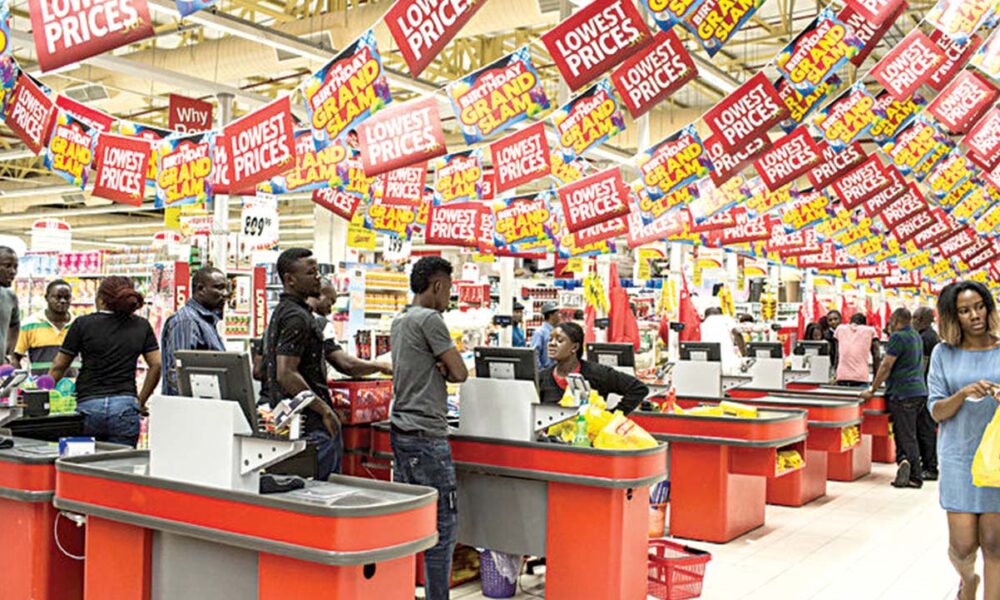
The controversy began when Barrister Uwadai Ogiobo, an intellectual property expert, walked into a popular retail chain. After paying for his goods, he was told he had to pay for a carrier bag. The catch? The bag was heavily branded with the store’s logo. “So, I will pay for a nylon that advertises your brand anywhere I carry the nylon to?” Uwadai asked.
His question struck a nerve, triggering a cascade of shared frustrations from other advocates like Tunji Faleye, John Salau, and Peter Jones, who reported similar experiences at major outlets like SPAR, Bokku, and Prestige.
At its core, this isn’t just about a 5 or 10 Naira fee. It is a fundamental question of equity. As Godwin Anyebe, the convener of the group, poignantly noted: “If a customer pays for that bag, they are essentially paying the business for the privilege of advertising for them.”
The defense often cited by retailers, and noted by Amechi Obiakpu during the discussion, is that customers are “pre-informed.” Stores claim that by announcing the charges in advance and offering a “Bring Your Own Bag” (BYOB) option, they are acting fairly.
However, this argument falls apart under the lens of behavioral economics. John Salau pointed out a significant policy “loophole”: the government’s move to ban single-use plastics has inadvertently given retailers a shield to charge for bags. While the environmental goal is noble, the execution is predatory.
As Anyebe argued, the “choice” to bring your own bag is often an illusion. Retail shopping is frequently spontaneous. If a consumer buys ten items, they are “psychologically forced” to buy the bag. At that moment, the bag is no longer an “extra”, it is the final, essential stage of the product itself. To unbundle it is to effectively raise the price of every item in the store without adding a single kobo of value.
Why does this happen so freely in Nigeria, a country with a robust FCCPC and a history of legal activism? Regulatory Fatigue: While Europe’s regulators act with surgical precision on “hidden costs,” Nigerian enforcement often feels reactive rather than proactive.
The “Penny-Pinching” Culture: In a struggling economy, businesses are desperate to protect margins. However, as Anyebe noted, if a business cannot absorb the microscopic cost of a bag, consumers begin to wonder where else, safety, quality, or weight, the business is cutting corners.
The Peak-End Rule: In customer psychology, the “peak-end rule” suggests that we judge an experience based on how it felt at its end. Forcing a consumer to pay to advertise a brand as their final interaction leaves a “bitter aftertaste” that erodes long-term brand loyalty.
To understand how far we have strayed, one only needs to look at the pillars of consumer protection that have governed the West for decades, pillars that Nigeria has adopted on paper but often ignores in practice.
Beyond the Nylon
The “Nylon Tax” is a symptom of a deeper malaise in the Nigerian retail sector: a lack of respect for the consumer’s sovereignty.
If a store wishes to charge for bags to save the environment, the bags should be plain and generic. If they want the bag to be a “walking advertisement,” then the marketing department should foot the bill, not the customer. To do both is a double-dip into the consumer’s pocket that John Calvin would have likely denounced from his pulpit.
For Nigeria to truly follow the path of global best practices, the FCCPC must look beyond grand-scale monopolies and address these “micro-aggressions” at the checkout counter. Until then, the Nigerian consumer remains in a peculiar state of “paying to serve”, subsidizing the very brands that treat their patronage as a burden rather than a blessing.
As the WhatsApp group discussion concluded, the consensus was clear: it is time for consumers to stop being “trapped” by the convenience of the moment and start demanding the dignity that the foundation of modern commerce once promised.