

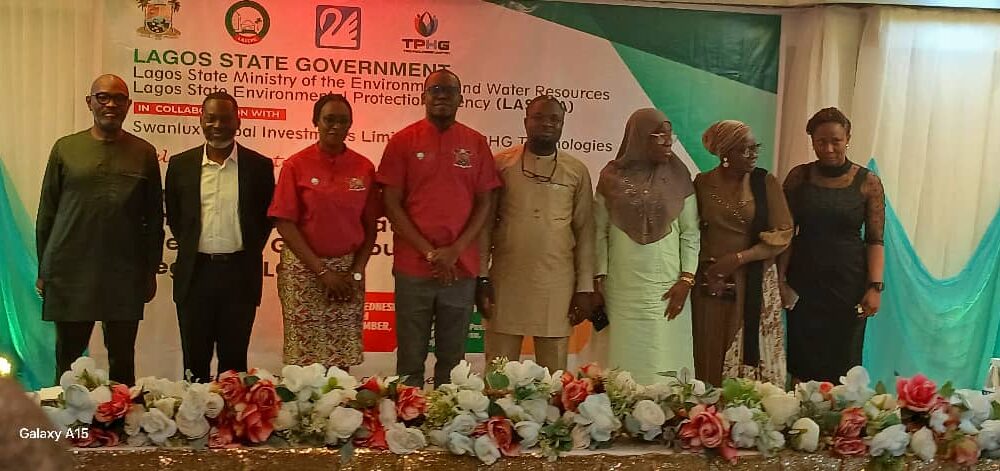




The discourse surrounding climate change mitigation in developing mega-cities often revolves around the challenge of balancing rapid industrial growth with environmental sustainability. In this context, the Lagos State Environmental Protection Agency (LASEPA), in collaboration with Swanux Global Investment Limited and TPHG Technologies Limited, has embarked on a seminal project: the implementation of the Lagos Greenhouse Gas Registry (LGHGR).

The Second Stakeholders’ Engagement on this initiative served not merely as an update session but as a robust articulation of the state’s commitment to verifiable environmental accountability, public health protection, and engagement with global carbon markets. Through detailed presentations from LASEPA’s leadership and its technical partners, the engagement established the LGHGR as a comprehensive, multi-sectoral tool designed to institutionalize carbon management within Nigeria’s economic hub.
The foundation of the LGHGR rests upon a principle of stringent accountability. As articulated by the General Manager of LASEPA, Dr. Tunde Ajayi, in his welcome address, the global energy transition necessitates a decisive move away from fossil fuels, a shift that “has to start with accountability.” He emphasized that the registry is a fundamental mechanism to measure Lagos State’s journey towards this goal. Dr. Ajayi contextualized the urgency by highlighting the tremendous environmental pressure exerted by the state’s expanding population, noting the daily influx of approximately 2,000 people who invariably contribute to the growing urban emissions load. The core belief driving the registry’s establishment is that putting an empirical measure of accountability in place will intrinsically lead to a reduction in the city’s overall carbon footprint.
Furthermore, the mandate of the LGHGR is inextricably linked to the protection of public health—a factor Dr. Ajayi defined as a cornerstone of environmental policy. He starkly summarized this connection, stating that everything undertaken in environmental protection is tied to public health, and “the quality of life you have is tied to the pollution in your environment.”
By measuring and coordinating emissions through the LGHGR, LASEPA aims to enforce the right policies that address pollution’s immediate consequences. Given that Lagos, like any major industrial city, experiences significant pollution, the agency views its efforts as positioning Lagos ahead of the curve. LASEPA’s role is therefore centered on data verification, continuous stakeholder engagement, and critically, holding organisations responsible.
Dr. Ajayi presented the economic argument for this approach, concluding that the individual cost of robust environmental protection is fundamentally cheaper than the long-term burden of healthcare costs associated with pollution-related diseases. The collaborative success of this ambitious initiative was also underscored by Mrs. Ayodeke Oso, Director of the Air Quality and Emissions Control Unit at LASEPA, who noted in her goodwill message that the LGHGR’s achievement “is dependent on the participants,” stressing the need for collective attention and collaboration given the environment’s dependence on the decisions made today.
The necessity of the LGHGR is quantified by startling economic and environmental projections. Dr. Mofoluso Fagbeja, a consultant at TPHG Technologies Limited, presented the compelling case for global alignment, arguing that pollution recognizes “no boundaries” and necessitates a monitoring system that scales from local to international levels. He declared that Lagos State must urgently integrate with global carbon trading emissions mechanisms to effectively checkmate pollution.
Dr. Fagbeja presented empirical estimates, revealing that Lagos currently generates approximately 20 million tonnes of $CO_2$ emissions, with the pervasive use of generators contributing a substantial 25% to this total. The potential damage caused by unchecked emissions is projected to reach an estimated $50 billion by 2050.
Beyond damage mitigation, the registry is strategically designed to unlock economic value. By converting all documented greenhouse gases to $CO_2$ equivalents, the LGHGR is set to enhance investment in clean technology, create income from emissions trading, and significantly improve the competitiveness of Lagos-based entities on both local and global stages. This economic dimension positions the LGHGR not as a compliance burden, but as a catalyst for green investment and job creation across manufacturing, transport, and agriculture.
To ensure effective implementation, the technical partners presented a robust regulatory and governance framework. Mary Ayodeji of TPHG Technologies Limited outlined the regulations, confirming their alignment with Nigeria’s national carbon reporting standards and their application to both private and public entities across all economic strata.
The LGHGR will operate under a Public-Private Partnership (PPP) model managed by LASEPA, which will maintain the central data repository. The reporting requirements are granular, obligating entities to submit data quarterly, detailing energy consumption, including the specific litres of fuel used by vehicles and aircraft. This submission will be followed by a compulsory audit and verification process, culminating in the issuance of a verification certificate, with non-compliance attracting penalties.
Complementing the regulation, Rita Ario, also of TPHG Technologies Limited, detailed the governance structure, affirming that the General Manager of LASEPA will serve as the Chairman of the LGHGR’s board. This structure includes an Advisory Board and sub-committees, with a Technical Advisory Committee specifically established to ensure the continuous transparency and integrity of all carbon-related activities.
Crucially, the success of the LGHGR rests on stakeholder capacity and operational clarity. Dr. Fagbeja emphasized that the LGHGR guidelines contain dedicated chapters addressing conflict resolution, compliance, penalties, and procedures for continuous alignment with both national and international climate goals.
A significant component of the implementation strategy involves education capacity for the registry, including a Corporate Social Responsibility (CSR) programme to lecture at higher institutions. This initiative aims to address the acknowledged human resource gap in fields like carbon accounting and emissions inventory, ensuring a future pool of skilled professionals.
Operationally, organizations are required to nominate a computer-literate frontline officer. Furthermore, the registry’s carbon accounting and reporting standard is meticulously designed to ensure seamless operation at both local and international levels, allowing Lagos entities to participate in global markets without conflict.
Rita Ario provided final clarity by detailing the data collection template, which demands specific data points that go beyond general consumption figures. Organisations must report all combustion equipment, electricity use, the volume of fuel in generators, fuel used by motor vehicles, the style and quantity of open waste disposal in tonnes, the presence of fire extinguishers, and even livestock activities. This level of data granularity ensures accurate emissions attribution and effective policy intervention.
In conclusion, the Second Stakeholders’ Engagement marked a definitive commitment by LASEPA, Swanux Global Investment Limited, and TPHG Technologies Limited to institutionalize climate action in Lagos. The LGHGR is designed as a transformative tool that simultaneously addresses critical public health threats, mitigates future economic damages from pollution, and strategically positions the state to capitalize on emerging global carbon finance opportunities.
By embedding strict accountability, robust governance, and comprehensive data collection across all economic sectors, the LGHGR sets a commendable standard for climate resilience in the African mega-city landscape. The future of Lagos’s environment and economy now hinges on the diligent and collaborative execution of this pioneering registry.